
Your website might pull in hundreds of visitors a month, yet the phone barely rings and the contact form sits empty. That gap between traffic and actual leads is the most common frustration among Alberta service, trades, and industrial businesses that already invest in marketing but aren’t seeing the return they expected.
The fix comes down to improving website conversion rates, meaning the percentage of visitors who take action, whether that’s requesting a quote, booking a consultation, or calling your office. This guide from Cutting Edge Digital Marketing walks through 12 proven strategies covering design, trust-building, forms, messaging, testing, and follow-up, all aimed at turning more of your existing traffic into qualified leads without spending another dollar on ads.
Each strategy below builds on the last, so let’s start with the numbers behind why conversion rate work pays off so quickly.
Key Takeaways
Raising your conversion rate from 2% to 4% can double qualified leads without any increase in ad spend.
First impressions, page load speed, and mobile design determine whether visitors stay or leave within seconds.
Trust signals like reviews, testimonials, and certifications carry extra weight for high-ticket B2B and trades decisions.
Structured testing and tracking, not guesswork, produce conversion gains that actually last.
Table of Contents
- What Is a Website Conversion Rate, and Why Does It Matter?
- Strategy 1: Start With a Full Website Audit
- Strategy 2: Build a Professional, Mobile-First Website Design
- Strategy 3: Craft Calls-to-Action That Actually Get Clicked
- Strategy 4: Use Social Proof to Build Instant Trust
- Strategy 5: Simplify Your Forms to Reduce Drop-Off
- Strategy 6: Create Dedicated Landing Pages for Campaigns
- Strategy 7: Improve Content and Messaging to Address Buyer Objections
- Strategy 8: Test, Track, and Optimize With Real Data
- Strategy 9: Align Marketing, Sales, and Follow-Up for Higher Close Rates
- Strategy 10: Set Realistic Conversion Goals and Measure ROI
- The Takeaway
- Frequently Asked Questions
What Is a Website Conversion Rate, and Why Does It Matter?
The top strategies to increase website conversion rates in 2026 all start from the same baseline number, which is the share of visitors who complete a specific action on your site. You calculate it by dividing total conversions by total visitors and multiplying by 100, so 50 form submissions from 1,000 visitors equals a 5% conversion rate. Service-based businesses typically land between 2% and 5%, while top performers reach 10% or higher, a range consistent with broader e-commerce conversion rate benchmarks showing similar spreads between average and top-performing sites. Sources like Unbounce and CXL publish similar benchmarking data each year, and those numbers are worth checking against your own results.
This math matters most for businesses spending $2,000 to $10,000 a month on marketing, because conversion rate directly controls cost per lead. Take a company investing $5,000 monthly that lifts its rate from 2% to 4%, this effectively doubles qualified leads from the exact same traffic and spend. That’s a bigger return than most businesses get from simply increasing their ad budget.
Strategy 1: Start With a Full Website Audit
A full website audit shows you exactly where visitors are dropping off before you change anything on the site. It’s the necessary first step for improving website conversion rates, and it means checking your traffic sources, page load speed, mobile function, form performance, and content clarity, using tools like Google Analytics to see which pages hold attention and which ones cause exits. Heatmap and session recording platforms such as Hotjar or Crazy Egg add a visual layer to this audit, showing where visitors click, scroll, and lose interest.
Proper tracking infrastructure needs to be in place before any of this data means much, since you can’t fix a leak you can’t see. This is a core principle at Cutting Edge Digital Marketing, where every conversion project starts with verifying tracking is accurate so future decisions rest on real numbers rather than assumptions. Skipping this step is the single biggest reason optimization efforts stall.
Strategy 2: Build a Professional, Mobile-First Website Design
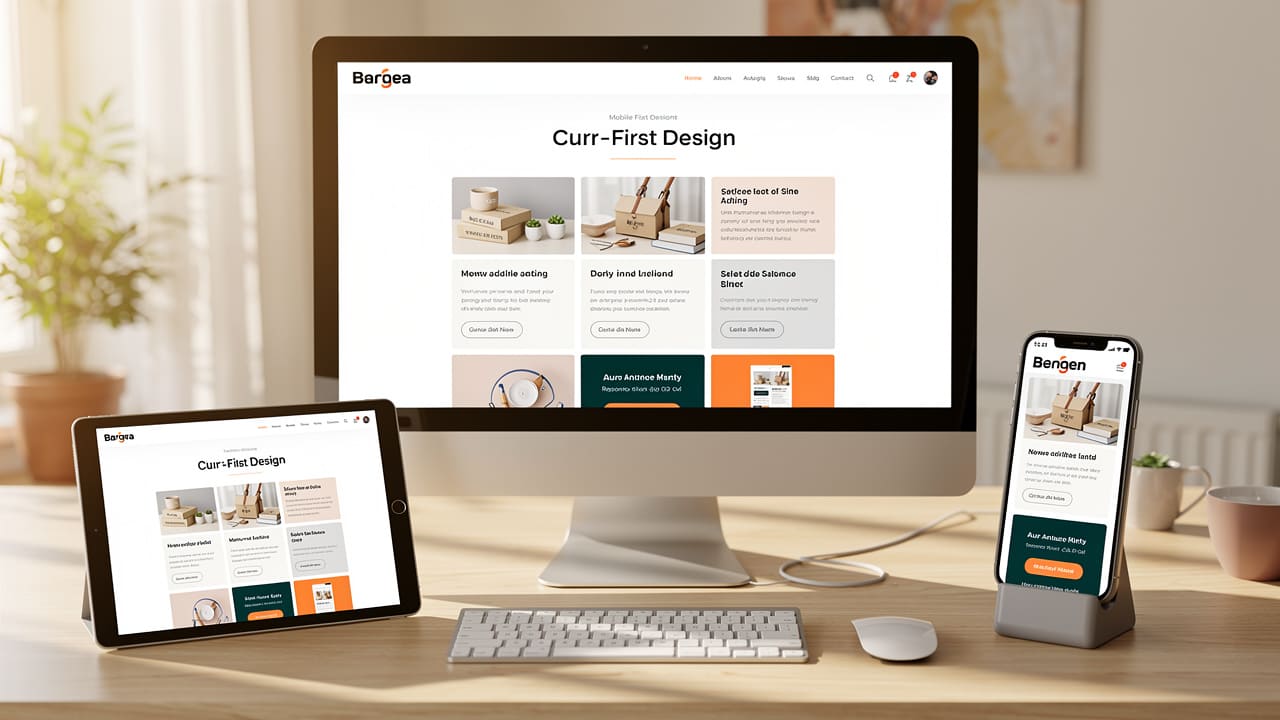
A professional, mobile-first design directly shapes whether a visitor trusts your business within the first few seconds on your site. For construction companies, contractors, and industrial website design principles, an outdated or clunky website raises doubt about whether the same shortcuts show up in the actual work, while a clean, modern layout signals that your standards are consistently high across the board. Mobile responsiveness isn’t optional anymore, since more than 60% of web traffic now comes from phones and tablets, and a site that breaks or loads slowly on a smartphone loses the website development for trades your services. Cutting Edge Digital Marketing builds every site around this reality, designing for mobile first and layering desktop refinements on top rather than the other way around.
Several design elements work together to hold attention and guide visitors toward action.
Visual hierarchy organizes the page so the eye naturally lands on your contact button, phone number, or quote form first, rather than getting lost among competing headlines and images.
White space around key elements like buttons and headlines makes them stand out instead of blending into a crowded page.
Consistent branding across every page (colours, fonts, and imagery) builds the kind of recognition that reassures industrial and trades buyers they’re dealing with an established operation.
Fast-loading images and clean code keep the technical experience smooth, which matters just as much as the visual polish itself.
How Does Page Speed Affect Conversion Rates?
Page speed affects conversion rates because every additional second of load time increases bounce rate and lowers the odds a visitor stays to convert. Research from Think with Google’s mobile page speed benchmarks found that a majority of mobile visitors abandon pages taking longer than three seconds to load. Running your site through Google PageSpeed Insights, then CDN services for speed, are quick fixes that pay off fast.
Strategy 3: Craft Calls-to-Action That Actually Get Clicked

A call-to-action, or CTA, is the button or line of text that turns an interested visitor into a lead, and its wording and placement matter more than most business owners assume. Placing your main CTA above the fold, meaning visible before any scrolling, generates more clicks than burying it at the bottom of the page. Repeating that same CTA at logical points further down the page (after a service description or testimonial) gives visitors more chances to act at the moment they’re most convinced.
Button design plays an equally important role in whether that CTA gets noticed at all. Colours like orange, green, or bright blue tend to outperform neutral tones because they contrast against typical page backgrounds, and buttons need enough surrounding white space to avoid getting lost among other elements. Size matters too, especially on mobile, where a cramped button becomes nearly impossible to tap accurately.
The words on the button carry real weight in the decision to click. “Get Your Free Quote” or “Schedule Your Site Assessment” outperforms a generic “Submit” because it tells the visitor exactly what happens next and what they gain. For trades and industrial buyers specifically, action language tied to a concrete benefit, such as “Book Your Free Equipment Inspection,” removes hesitation better than vague alternatives ever could.
Strategy 4: Use Social Proof to Build Instant Trust

Social proof works by giving visitors evidence, before they ever pick up the phone, that other customers trusted your business and got results, a dynamic confirmed by research on the impact of user experience on conversion rates showing trust cues directly shape buyer behavior on e-commerce and service sites. This matters even more for high-consideration B2B and service purchases, where a wrong hire can mean blown budgets, missed deadlines, or safety risks, so buyers actively look for reassurance before reaching out. A contractor with client testimonials on camera describing quality work builds more confidence than the same words in plain text, and recognizable regional client logos tell Alberta-based buyers that established local companies already trust you.
Several credibility signals consistently move the needle on conversion.
Video testimonials add authenticity that written reviews can’t fully match, since seeing a real client describe their experience feels harder to fake.
Case studies walk through the full project, from the original problem through the solution and measurable outcome, which matters most for industrial and equipment buyers evaluating complex purchases.
Certifications and licences relevant to construction, trades, or oil and gas work reassure visitors that your business meets regulatory and professional standards.
get more Google reviews carry outsized weight locally, since a location with dozens of five-star reviews consistently outperforms one with none at all.
Why Do Case Studies Convert Better Than Testimonials?
Case studies convert better than testimonials because they show the full picture, the original challenge, the solution you delivered, and the measurable result, rather than a single quoted opinion. That level of context matters most to industrial and equipment buyers weighing a complex purchase, since they need proof you’ve solved a similar problem before, not just praise for your customer service.
Strategy 5: Simplify Your Forms to Reduce Drop-Off

Every extra field on your contact form gives a visitor one more reason to abandon it, which makes simplicity one of the fastest wins available for improving website conversion rates, a pattern also visible in case studies where simplified funnels drove a 67% higher conversion rate alongside lower cost per lead. A form asking only for name, email, phone number, and a brief description of the need converts far better than one demanding project budget, timeline, and a dozen other details upfront. Tools like Gravity Forms or Typeform make it easy to build shorter, cleaner forms without sacrificing the data you actually need. Save the deeper qualifying questions for the actual sales conversation, once the lead is already engaged.
Mobile form design deserves its own attention, since a growing share of your leads will submit from a phone. Single-column layouts, appropriately sized input fields, and buttons large enough to tap accurately all reduce the frustration that causes mobile visitors to give up halfway through. Real-time validation, meaning the form flags an incorrectly formatted email or phone number immediately rather than after submission, prevents a frustrating cycle of resubmission attempts.
What happens right after submission matters just as much as the form itself. A generic “thank you” message leaves visitors unsure whether their request actually went through, while a confirmation email that restates what was submitted and sets a clear expectation for follow-up time builds confidence and reduces no-shows on the sales calls that follow.
Strategy 6: Create Dedicated Landing Pages for Campaigns
A dedicated landing page is a standalone page built for one specific campaign, and it consistently outperforms sending that same paid traffic to your general homepage. Our landing page optimization tips start with message match. When a Google Ads strategy lead generation promises “Free Commercial Roofing Quotes,” the landing page headline needs to repeat that exact promise immediately, or visitors question whether they landed on the right page and leave. This message match between ad and page is one of the simplest, highest-impact fixes available to businesses running paid search or social campaigns.
Single-focus pages built around one offer, rather than a menu of services, remove the decision paralysis that comes with too many options, which aligns with data showing what counts as a good landing page conversion rate in 2026 tends to come from tightly scoped, single-offer pages. A landing page dedicated purely to “Emergency HVAC Repair” converts better than one also promoting maintenance plans and full installations, because the visitor’s attention stays locked on the exact thing that brought them there. Supporting elements like a strong testimonial, a certification badge, or a specific guarantee reinforce that focused message without pulling attention away from it. Platforms like Optimizely and VWO let larger advertisers test multiple landing page variants against each other to find the strongest performer.
CTA placement on these pages follows the same logic as your main site, with the button visible above the fold and repeated again further down the page. The team at Cutting Edge Digital Marketing builds landing pages this way specifically for paid advertising clients, pairing tight message match with proof elements suited to each industry, whether that’s a fabrication shop or an equipment rental company.
Strategy 7: Improve Content and Messaging to Address Buyer Objections
Website content improves conversion rates when it answers the objections a prospect would otherwise raise on a sales call, before they ever pick up the phone. Service descriptions written around outcomes, rather than technical specifications alone, connect better with buyers who care about project timelines, cost certainty, and quality more than the specific equipment or method used. Instead of listing “10-tonne capacity equipment,” explaining how that capacity reduces downtime speaks directly to what the buyer actually wants solved.
Anticipating common concerns and addressing them directly removes friction at exactly the point where hesitation usually kills a lead. Trades buyers worry about reliability and fair pricing, construction clients worry about delays and unexpected costs, and industrial buyers worry about implementation timelines and training requirements. Writing directly to these specific worries, rather than generic marketing copy, shows the visitor you understand their situation before they’ve said a word.
Frequently asked questions sections and short educational guides do a lot of this work automatically. A construction company publishing a short guide on “questions to ask before hiring a contractor” attracts organic search traffic while pre-answering the exact concerns that would otherwise come up during a phone call. This kind of content typically drives fewer direct conversions on its own, but it nurtures prospects who aren’t ready to contact you yet.
Strategy 8: Test, Track, and Optimize With Real Data
Testing and tracking turn conversion rate work from a one-time guess into a repeatable process that compounds over time. A/B testing for digital ads means creating two versions of a page with a single difference, such as swapping “Request a Quote” for “Schedule Your Free Consultation,” then measuring which version actually converts better with real visitors. Heatmaps and session recordings from tools like Hotjar or Crazy Egg add a visual layer to this data, showing exactly where visitors click, how far they scroll, and where they hesitate or give up entirely, while platforms such as Optimizely support more advanced multivariate testing for businesses with higher traffic volumes.
Conversion funnel analysis rounds out this picture by tracking where visitors drop out of the process. A handful of checks tend to reveal the most valuable insights.
Funnel drop-off points show whether the friction sits in getting visitors to click your CTA or in getting them to finish the form once they’ve started.
Traffic source performance often reveals that why blogs matter for SEO at a very different rate than paid ads, which should directly guide where you invest next.
Visitor segmentation by device, location, or traffic source frequently shows mobile and desktop users behaving in meaningfully different ways.
Looking ahead, more businesses are starting to layer AI-powered personalization and predictive analytics on top of this foundational testing. Dynamic content systems that adjust headlines, offers, or images based on visitor behaviour are becoming more accessible heading into 2026, and they work best once the fundamentals above, clean tracking, tested CTAs, and simplified forms, are already in place.
How Long Should You Run an A/B Test?
An A/B test needs to run long enough to reach statistical significance, which usually means collecting data from hundreds or thousands of visitors per version before drawing conclusions. Ending a test early, based on a small early lead for one version, often produces false results that don’t hold up once more traffic comes through. Patience here protects you from acting on noise instead of a real pattern.
Tip: Resist the urge to call a test early. A short-term lead for one version often disappears once enough visitors have seen both.
Strategy 9: Align Marketing, Sales, and Follow-Up for Higher Close Rates

Aligning marketing, sales, and follow-up closes the gap between a form submission and a signed contract. Conversion rate work doesn’t stop once a visitor submits a form, since the speed and consistency of what happens next determines whether that lead actually becomes a paying customer. Messaging needs to stay consistent across your Google Ads management for trades, SEO content, and website copy, because a prospect who sees “30% savings” in an ad but a website focused purely on quality gets confused about what you actually offer. Following up within 24 hours of a form submission dramatically increases the odds of converting that lead, while slower response times let interest cool off fast.
This is exactly where Cutting Edge Digital Marketing’s role as a strategic marketing partner comes in, website design and development advertising into one connected system rather than treating them as separate, disconnected efforts. When every channel points toward the same message and the same conversion goal, qualified leads move through the process with far less friction, and sales teams spend less time re-explaining what was already promised online.
Strategy 10: Set Realistic Conversion Goals and Measure ROI
Realistic conversion goals give your optimization work a clear target instead of vague hopes for “more leads.” Service-based businesses typically sit between 2% and 5%, with high-performing operations reaching 10% or higher, though your own starting point should guide what counts as meaningful progress rather than treating industry averages as a ceiling.
The financial case for this work becomes obvious once you run the numbers. If your average customer is worth $5,000 over their lifetime and your site gets 10,000 visitors a year, moving from a 2% to a 3% conversion rate adds roughly $500,000 in additional customer value, without spending another dollar on traffic.
| Performance Level | Typical Conversion Rate | What It Usually Means |
|---|---|---|
| Below average | Under 2% | Site likely has design, speed, or trust issues |
| Typical | 2% to 5% | Standard range for most service-based businesses |
| High performing | 5% to 10% | Strong trust signals and optimized CTAs/forms |
| Exceptional | Above 10% | Comprehensive, ongoing optimization in place |
The Takeaway
Improving website conversion rates isn’t a single fix you apply once and forget, it’s an ongoing discipline that compounds as you test, measure, and refine over months and years. The highest-impact starting points from this guide are a full audit, professional mobile-first design, strong trust signals, simplified forms, and consistent testing, in roughly that order of priority for most established service and trades businesses.
If your traffic isn’t turning into enough qualified leads, the answer usually isn’t more ad spend, it’s a stronger foundation underneath the traffic you already have. Cutting Edge Digital Marketing works with Alberta and Western Canadian service, trades, and industrial website development agency partner, building websites, tracking, and campaigns around one clear goal, which is converting more of your visitors into real, measurable revenue.
Frequently Asked Questions
The following answers address the most common questions Alberta service and trades businesses ask when they start working on conversion rate improvements.
What Is a Good Website Conversion Rate for a Service-Based Business?
Most service-based businesses see conversion rates between 2% and 5%, while high performers reach 10% or higher. Your realistic benchmark depends heavily on your industry, traffic sources, and how competitive your local market is, so treat these figures as a general guide rather than a fixed target.
How Much Does It Cost to Improve Website Conversion Rates?
Costs vary widely depending on scope, from a focused audit and quick fixes to a full website redesign with new tracking and content. In most cases, the return from optimizing your existing traffic exceeds what you’d get from simply increasing ad spend without fixing the underlying conversion issues first.
How Quickly Can I See Results From Conversion Rate Optimization?
Quick wins like CTA wording, button colour, or form field reduction can show measurable results within a few weeks of implementation. Deeper structural changes, such as a full redesign or new landing page strategy, take longer to build and validate through proper testing before results become clear.
Do I Need a Lot of Website Traffic to Run Conversion Tests?
Low-traffic sites should lean on qualitative tools like heatmaps and session recordings rather than formal A/B tests, since split tests need real volume to produce reliable results. Focus first on high-impact, low-traffic-dependent fixes, such as clearer CTAs and simpler forms, before attempting statistical testing.
What’s the Difference Between Conversion Rate Optimization and SEO?
SEO drives more visitors to your site, while conversion rate optimization strategies improves what happens once those visitors arrive. The two work best together, which is why this agency treats them as one connected system rather than separate, unrelated services.
Should I Redesign My Whole Website or Make Small Changes First?
Start with a full audit to identify quick wins, like CTA placement or form length, before committing to a complete redesign. A full rebuild becomes worthwhile when your site is genuinely outdated, built on a generic template, or missing the mobile responsiveness that modern visitors expect.