A contractor’s proposal and a competitor’s proposal often read almost word for word the same, right down to the promises of “quality workmanship” and “competitive pricing.” That sameness is the real problem behind weak marketing, since a business that sounds like everyone else forces prospects to decide based on price alone. Strong unique selling proposition examples solve that problem by replacing generic claims with something specific enough that no competitor could honestly copy it.
A strong unique selling proposition is a specific, provable reason customers choose you over competitors, such as a 60-minute response guarantee or a written no-change-order policy. This guide breaks down real examples across construction, trades, industrial supply, food, and personal branding, plus a repeatable framework for building your own USP.
A unique selling proposition is the exact, provable reason a customer picks your company over every other option in the market, and it has to hold up under scrutiny rather than just sound good on a website. This guide from Cutting Edge Digital Marketing breaks down the categories that strong USPs fall into, walks through real examples across construction, trades, industrial supply, food, and personal branding, and lays out a repeatable framework for building one that survives contact with a skeptical buyer.
Keep reading to see how a well-built USP turns marketing spend into qualified leads instead of guesswork.
Key Takeaways
A real USP is specific and provable, never a vague slogan like “quality service.”
Strong USPs fall into recognizable categories, including speed, guarantees, specialization, and service culture.
Industry-specific examples convert better than borrowed consumer taglines.
A USP only drives revenue when it’s applied consistently across your website, ads, and sales calls.
Professional marketing support helps validate a USP and scale it correctly once it’s proven.
Table of Contents
- What Is A Unique Selling Proposition, And Why Does It Matter?
- Unique Selling Proposition Examples By Category
- Unique Selling Proposition Examples By Industry
- How To Create A Unique Selling Proposition For Your Business
- Common Mistakes That Weaken A USP
- Turning Your USP Into Consistent, Qualified Leads
- To Sum Up
- Frequently Asked Questions
What Is A Unique Selling Proposition, And Why Does It Matter?

A unique selling proposition is the single, provable reason a prospective customer chooses your company instead of a competitor, and understanding how to develop a strong USP starts with knowing what separates a real differentiator from a slogan. Real USP examples that convert customers point to a measurable promise, a 60-minute response window, a decade-long safety record, a written no-change-order guarantee, rather than a vague nod to “quality” or “experience.” For service, trades, and industrial businesses across Alberta, that distinction carries real financial weight, since a construction firm or equipment supplier without a defined USP competes almost entirely on price when prospects have no other basis for comparing near-identical bids.
That commoditization pressure quietly erodes margins year after year, even for companies doing genuinely excellent work. A clearly articulated USP shifts the conversation from “who’s cheapest” to “who delivers the outcome I actually need,” which is exactly what separates businesses that digital marketing from those stuck chasing referrals alone.
What Makes A USP Genuinely Effective?
A genuinely effective USP passes four quick tests before it ever reaches a website or ad campaign:
Specific names a number, timeframe, or certification instead of leaning on adjectives like “great” or “reliable”
Relevant matters to the customer’s actual pain point, whether that’s minimizing equipment downtime or avoiding a surprise invoice
Provable backed by certifications, warranties, or documented results
Defensible hard for a competitor to copy overnight
A USP built on a temporary price promotion disappears the moment someone undercuts it, while one built on specialized expertise or a proven process tends to hold up for years.
Unique Selling Proposition Examples By Category
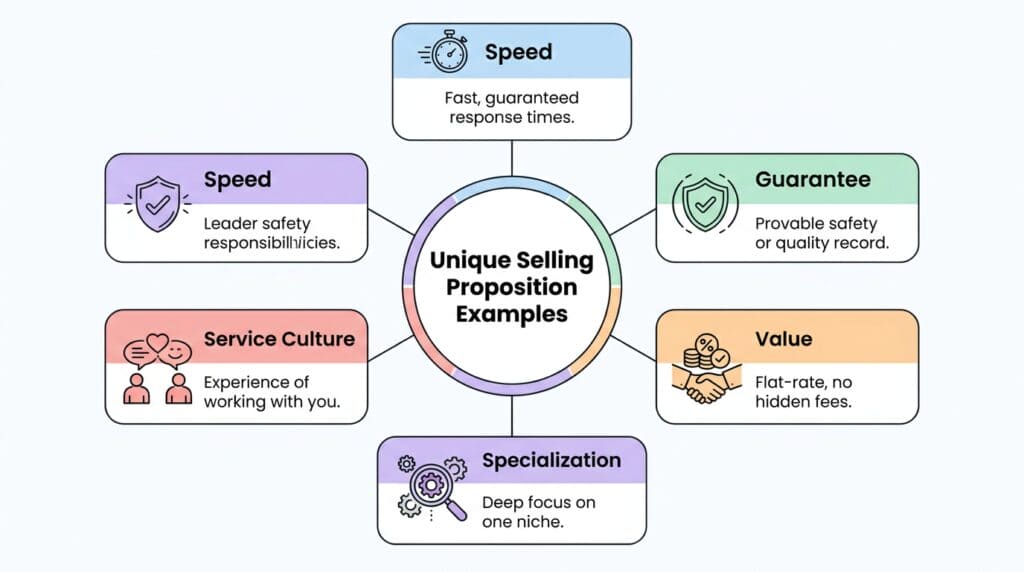
Most strong USPs fall into a handful of repeatable categories rather than requiring some flash of inspiration nobody else has thought of, and recognizing those categories makes your own messaging much easier to audit. Once you can name the category a claim belongs to, it’s far simpler to spot where a vague statement could become something concrete and provable. The unique selling proposition examples below are organized by strategic angle, drawing on real patterns from construction, trades, and industrial companies, so you can see how each principle translates into language you could realistically use.
Speed, Guarantees, And Value-Based USPs

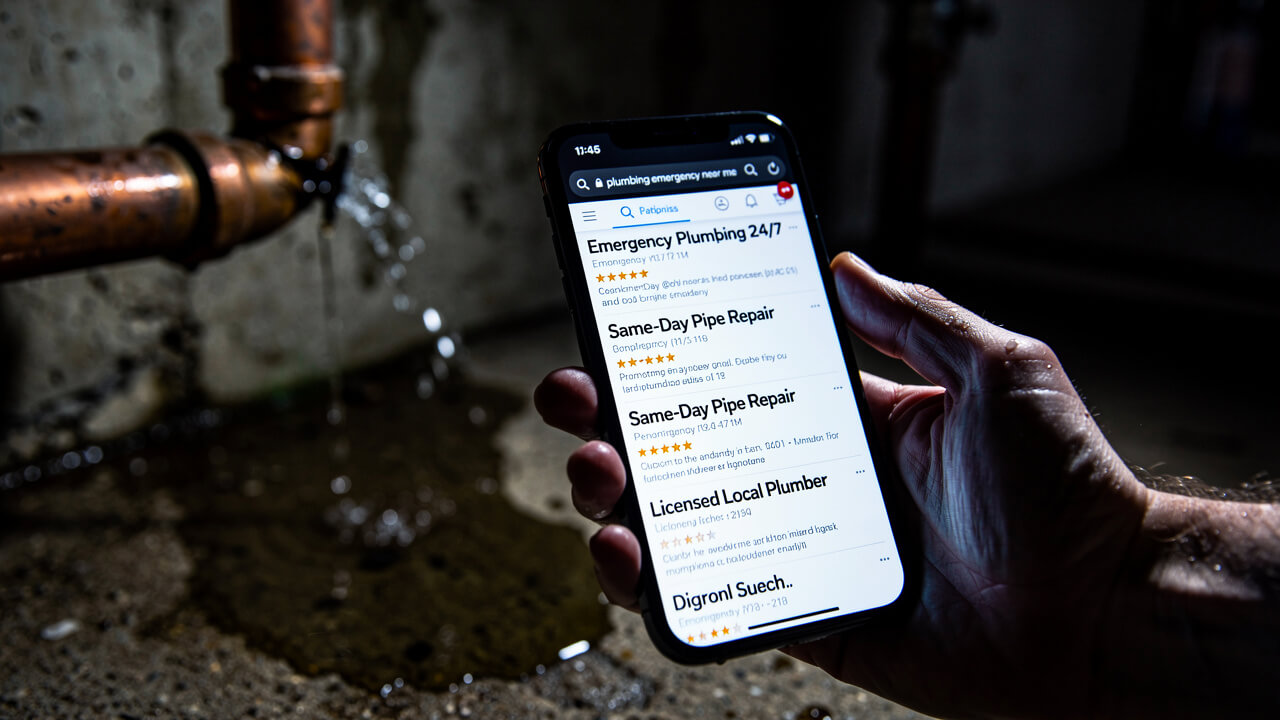
Speed and guarantee-based USPs work because they remove risk from a customer’s decision at the exact moment it matters most, whether that’s a burst pipe at midnight or an industrial line that just went down. These promises succeed when they’re measurable and backed by a real operational commitment, not just a phrase printed on the side of a truck.
| Category | Example USP | Why It Works |
|---|---|---|
| Speed | 60-minute emergency response, guaranteed | Removes uncertainty during a time-sensitive crisis |
| Guarantee | Zero lost-time incidents in 10 years | A provable safety record builds trust with corporate buyers |
| Value | Flat-rate pricing, no hidden fees | Eliminates the fear of a surprise invoice |
One of the more famous USP examples comes from the pizza delivery industry’s old 30-minute guarantee, which turned a simple time promise into one of the most recognized differentiators in consumer history. The lesson translates directly to trades and industrial work: a specific, risk-reversing promise can carry more weight than a long list of generic benefits.
Specialization, Quality, And Service-Culture USPs
Specialization works because narrowing your focus signals depth of expertise a generalist competitor simply can’t match. A contractor who says “we exclusively serve oil and gas equipment operators” tells an industrial buyer there’s no learning curve and no divided attention during a critical project, while a craftsmanship claim like a 25-year workmanship warranty signals confidence a standard one-year warranty can’t match.
Service-culture USPs take a different angle, differentiating on the experience of working with a company rather than the technical work itself. A promise like “one dedicated project manager, zero runaround” addresses a frustration nearly every trades or industrial client has felt with a past vendor. For contrast, a well-known outdoor apparel brand built decades of loyalty around a lifetime product guarantee, one of several unique selling proposition examples that show how a single, consistently honoured promise can define a brand far beyond its original category.
Unique Selling Proposition Examples By Industry
Industry context changes which category of USP resonates most, since a construction client manages different risks than a homeowner calling an emergency plumber. The examples below are written as adaptable templates, meant to be adjusted with your own numbers, certifications, and service area rather than copied word for word. Seeing how the same principles apply across construction, trades, industrial supply, food service, and personal branding makes it easier to find the right angle for your own business.
Examples For Construction, Trades, And Industrial Companies

Construction, trades, and industrial companies tend to win business with USPs built around certainty, since buyers in these sectors often manage budget, safety, and schedule risk at the same time. A general contractor might promise “fixed-price contracts with a written no-change-order guarantee,” which directly addresses the single biggest fear in commercial construction: budget creep. A trades company might lead with “24/7 emergency plumber search with a real person answering the phone, not a call centre,” a small operational detail that matters enormously to someone standing in a flooded basement.
Industrial and equipment suppliers, meanwhile, often differentiate through logistics and specialization rather than price. A claim like “48-hour parts delivery anywhere in Western Canada” speaks directly to plant operators for whom downtime costs far more than the part itself. Pairing that promise with a credential such as ISN or ComplyWorks certification adds the proof sophisticated industrial buyers expect before trusting a new supplier.
Unique Selling Point Examples For Food, Coffee, And Personal Brands

Coffee and food businesses often build their strongest USP around experience rather than the product alone, since coffee itself is a heavily commoditized category. A USP for coffee brands might position the shop as a consistent “third place” between home and work, or build the menu around a specific sourcing story, such as direct relationships with a small number of farms, giving customers a reason to choose one shop over a dozen others on the same street.
Personal unique selling point examples follow the same logic of narrow, provable specificity, echoing recent research on personal brand equity that emphasizes measurable credibility over vague self-promotion. A project manager might position themselves as “the only certified [credential] project manager in [region] with 15 years focused exclusively on industrial retrofits,” combining a credential, a geography, and a track record into one memorable claim. That structure, one specific skill plus proof plus a defined niche, applies equally well to a tradesperson building a personal brand or an entire company.
How To Create A Unique Selling Proposition For Your Business
Building a unique selling proposition is a research exercise, not a brainstorming session where someone tries to land on a clever line. The strongest USPs emerge at the intersection of what a business is genuinely good at and what competitors either can’t or haven’t bothered to claim. The framework below walks through that process in order, followed by a simple template for drafting the actual statement.
A Step-By-Step Framework To Define Your USP
Audit the competition note every claim already in use, since phrases like “quality service” and “years of experience” show up so often they’ve become meaningless to buyers
List your provable strengths certifications, response times, warranty terms, safety records
Find the gaps cross-reference that list against what competitors left uncovered
Ask existing customers long-term clients can usually explain why they stayed even when your internal team can’t
Narrow and test pick one core, measurable claim and test it in real ad copy or sales conversations before committing to it across your entire brand
Unique Selling Proposition Template
A simple fill-in-the-blank structure makes drafting the actual statement far less intimidating than staring at a blank page.
“The only [business type] in [area or niche] that [specific, provable claim], backed by [proof point].”
The brackets force specificity, which is exactly what separates a real USP from a slogan.
Applied to a trades business, that might read: “The only HVAC company in Central Alberta guaranteeing a technician on-site within 90 minutes, backed by a decade of zero missed appointments.” Run a handful of variations through that structure, then test them with your sales team and a few trusted customers before picking a final version.
Common Mistakes That Weaken A USP
The most common mistake is settling for language so generic that any competitor could claim the exact same thing, word for word. Phrases like “quality you can trust” or “customer-focused service” fail because they’re unprovable and used across virtually every industry, registering as background noise rather than a reason to choose you. A close second is trying to appeal to absolutely everyone, which usually produces a message so broad it fails to resonate with anyone in particular.
Overpromising causes damage that outlasts any short-term marketing benefit, since a guarantee your operations can’t consistently deliver turns a differentiator into a liability. Just as risky is letting a USP go stale, since a claim accurate five years ago may no longer reflect current certifications, service areas, or competitive realities. Reviewing your positioning after major growth milestones keeps the message honest and current.
Turning Your USP Into Consistent, Qualified Leads

A unique selling proposition only generates return on investment once it’s applied consistently across every channel a prospect might encounter, a pattern consistent with research on leveraging social media marketing for business success, which found consistent messaging strengthens customer engagement across platforms. The same specific claim needs to show up in Google Ads copy, service pages, proposals, and the way your sales team answers the phone, because inconsistent messaging dilutes even a genuinely strong differentiator.
This is where Cutting Edge Digital Marketing’s approach differs from agencies running templated packages. Rather than dropping a client into a generic website theme and a standard ad set, the team builds website design, SEO, and paid advertising around the specific USP a business has already proven it can deliver, keeping the message identical whether a prospect arrives through organic search or a Google Ads campaign.
That consistency pairs with proper conversion tracking, so a business spending $2,000 to $10,000 or more per month on marketing can see exactly which version of its message is generating qualified leads rather than just clicks. For established service, trades, and industrial businesses, that link between messaging and measurable revenue is what turns a well-written USP into a genuine growth asset. If your current messaging isn’t producing that kind of clarity, contact us to see how a proven USP could be built into your next campaign.
To Sum Up
A unique selling proposition earns its place in your marketing only when it’s specific enough that a competitor couldn’t honestly copy it, and provable enough that customers believe it on first read. The categories and unique selling proposition examples covered here, speed and guarantees, specialization and quality, service culture and niche credentials, give you a starting point, but the real work is auditing your own operations for the claims you can actually back up.
Take the framework and template above and test them against your current website, ad copy, and sales conversations, since most businesses find at least one message that’s currently too vague to convert. If you’d rather have an experienced partner handle that audit and turn the result into a full marketing system, Cutting Edge Digital Marketing works specifically with Alberta-based service, trades, and industrial businesses ready to make that shift.
Frequently Asked Questions
Question: What is an example of a good unique selling proposition for a small business?
A strong example is a local HVAC company promising transparent, flat-rate pricing shown before any work begins, with no hidden fees added afterward. This works because it’s specific, provable through a written quote, and addresses a fear nearly every homeowner has about unexpected invoices.
Question: How is a unique selling proposition different from a unique value proposition?
A unique selling proposition focuses on differentiation, the specific reason you beat competitors, while a unique value proposition example describes the overall value a customer receives regardless of competition. In practice, the terms overlap heavily, and many businesses use them interchangeably when describing what makes their offer worth choosing.
Question: Can a business have more than one USP?
Technically yes, but it’s rarely a good idea, since multiple competing claims dilute the message and make none of them memorable. The stronger approach is choosing one primary unique selling proposition and supporting it with two or three secondary proof points, such as certifications or guarantees.
Question: How often should a company update its USP?
Revisit your USP after any major growth milestone, new certification, expanded service area, or noticeable shift in what competitors are claiming. Most established businesses should formally review their positioning every 12 to 24 months, even if no single change feels significant enough to trigger it alone.
Question: What is the best unique selling proposition for a coffee brand?
The strongest coffee brand USPs lean on experience or sourcing story rather than the product alone, since coffee itself is highly commoditized. Positioning a café as a consistent “third place” between home and work, or highlighting direct farm relationships, gives customers a specific reason beyond price.
Question: How do I know if my USP is actually working?
A working USP shows up in higher conversion rates, reduced price objections during sales calls, and stronger referral rates because customers can clearly explain why they chose you. Growth in branded search volume over time is another reliable signal that the message is sticking.