
Your crews deliver solid work, yet the phone doesn’t ring as often as it should. Plenty of established trades and industrial companies in Alberta produce excellent projects but still struggle with inconsistent leads because their online presence doesn’t match their reputation on the job site.
This happens because today’s buyers, property owners, general contractors, and facility managers research contractors extensively online before ever picking up the phone. If your website, search rankings, or branding don’t reflect the quality of your work, you lose consideration to a competitor who simply shows up first in the search results.
Construction company marketing the combination of website optimization, local search strategy, paid advertising, content, and branding that generates qualified leads, solves this problem directly. This article covers how to build a lead-generating website, run multi-channel ad campaigns, create trust-building content, and why partnering with a team like Cutting Edge Digital Marketing can close the expertise gap most owners face. Keep reading to see where your current approach may be falling short.
Key Takeaways
A strong website and local SEO form the foundation of lead generation for construction companies.
Multi-channel paid advertising across Google, Meta, and LinkedIn delivers faster, trackable results than organic efforts alone.
Content, case studies, and professional branding build trust with commercial and industrial buyers over long sales cycles.
Tracking ROI is non-negotiable when managing marketing budgets between $2,000 and $10,000 per month.
A strategic marketing partner closes the in-house expertise gap most trades and industrial companies face.
What Makes Construction Company Marketing Different?

Construction company marketing differs from typical consumer marketing because it deals with long sales cycles, several decision-makers, and project-based revenue rather than quick, repeat purchases. A homeowner comparing renovation quotes decides within weeks, while a commercial project might involve a facility manager, a general contractor, and a procurement team working through several months of evaluation. Generic marketing templates built for retail or e-commerce simply don’t account for these realities, which is why construction, trades, and industrial companies need a specialized approach rather than an off-the-shelf package.
Property owners, general contractors, and facility managers now research companies thoroughly online long before they request a quote. They compare websites, review project portfolios, read client feedback, and look for proof of capability before making contact. If your digital presence doesn’t reflect the standard of your actual work, you lose that consideration before any conversation even starts.
How Do You Build a Lead-Generating Website and Local SEO Presence?
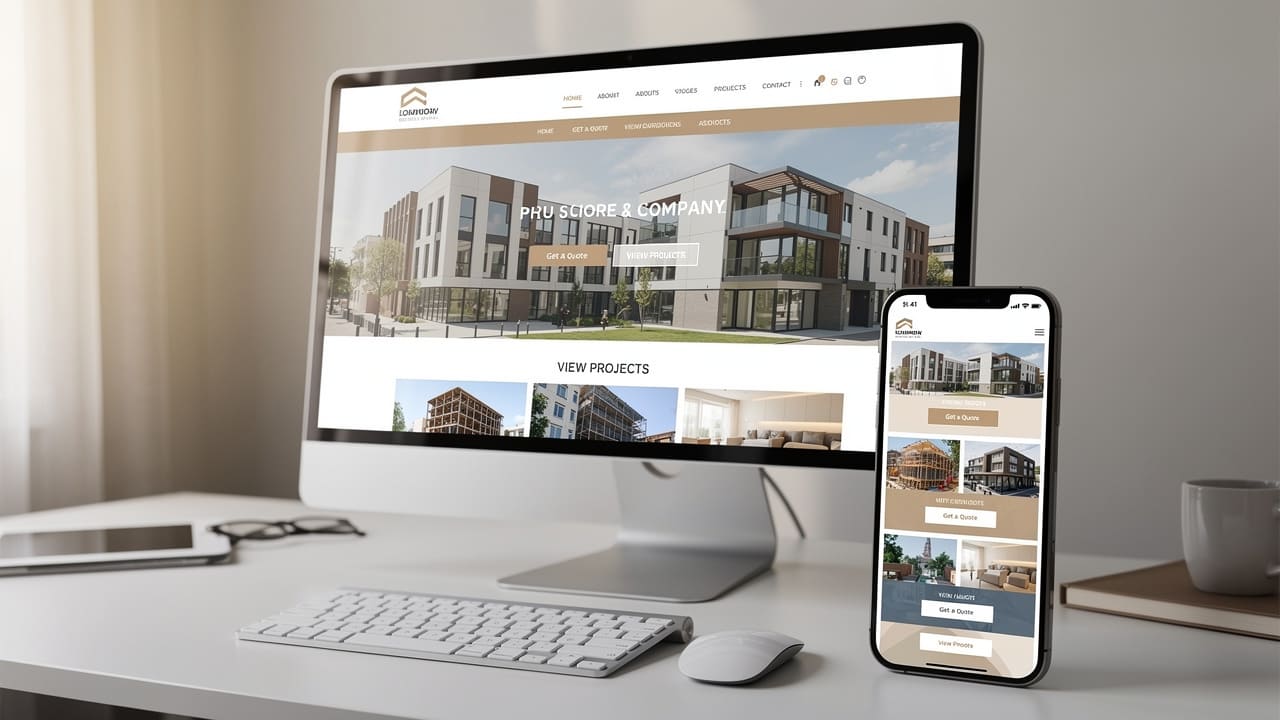
A lead-generating website answers one question fast: can this company handle my project? Construction companies need a quick-loading, mobile-friendly site because many property owners and facility managers search for contractors from a job site or between meetings, often on a phone rather than a desktop.
Here’s what a strong site needs:
Clear calls-to-action like “request a quote” or “call now”
Real project photography, not stock images
Simple navigation that separates services by residential, commercial, or industrial work
A fully optimized Google Business Profile showing accurate service areas, current hours, and photos of completed projects
Local keyword targeting, building pages around phrases like “commercial contractors in Edmonton” or “industrial fabrication in Calgary”
Consistent contact details across your website, directories, and social profiles
Beyond design, local search visibility determines whether your company even appears when someone searches for services in your area. Local keyword targeting helps you rank for the exact searches your ideal clients are typing, and consistent contact details reinforce the trust signals search engines use to rank local businesses. Encouraging satisfied clients to leave leave Google reviews adds another layer of trust that influences both rankings and conversion rates.
Why Local SEO Matters for Alberta-Based Trades Businesses
Alberta-based trades and industrial sector marketing compete within specific service areas, so ranking for city and region-based searches like “commercial contractors in Calgary” or “industrial equipment suppliers in Alberta” puts your business in front of buyers who are ready to act. Consistent citations across directories, accurate listings, and a steady stream of client reviews strengthen these local rankings over time. Without this focus, even a well-built website stays invisible to nearby buyers searching for your exact services.
What Are the Best Lead Generation Strategies for Construction Companies?
Consistent lead generation for construction companies combines paid advertising, referral relationships, and organized follow-up rather than relying on word-of-mouth alone. Here are the core strategies that drive results:
Multi-channel paid advertising through Google Ads strategy, Meta, and LinkedIn captures prospects at the exact moment they’re searching for services or browsing industry content, generating measurable leads within days instead of months.
Database segmentation by project type, industry, and location lets you send relevant messages instead of generic blasts, which keeps your company visible when prospects are finally ready to move forward.
Lead capture mechanisms matter just as much as traffic itself, since simple contact forms, downloadable project checklists, and landing page design all reduce friction and collect the details your sales team needs to qualify a prospect quickly.
Referral networks built with architects, engineers, and complementary trades create a steady flow of warm introductions that convert faster than cold leads because they arrive with built-in trust.
Response speed closes the loop too, since missed lead costs for a callback often move to a competitor, so companies serious about growth build systems that route inquiries to the right person immediately.
Together, these tactics build a pipeline that doesn’t depend on a single source, which matters most during slower seasons when one channel alone can’t carry the business.
Paid Advertising Across Google, Meta, and LinkedIn
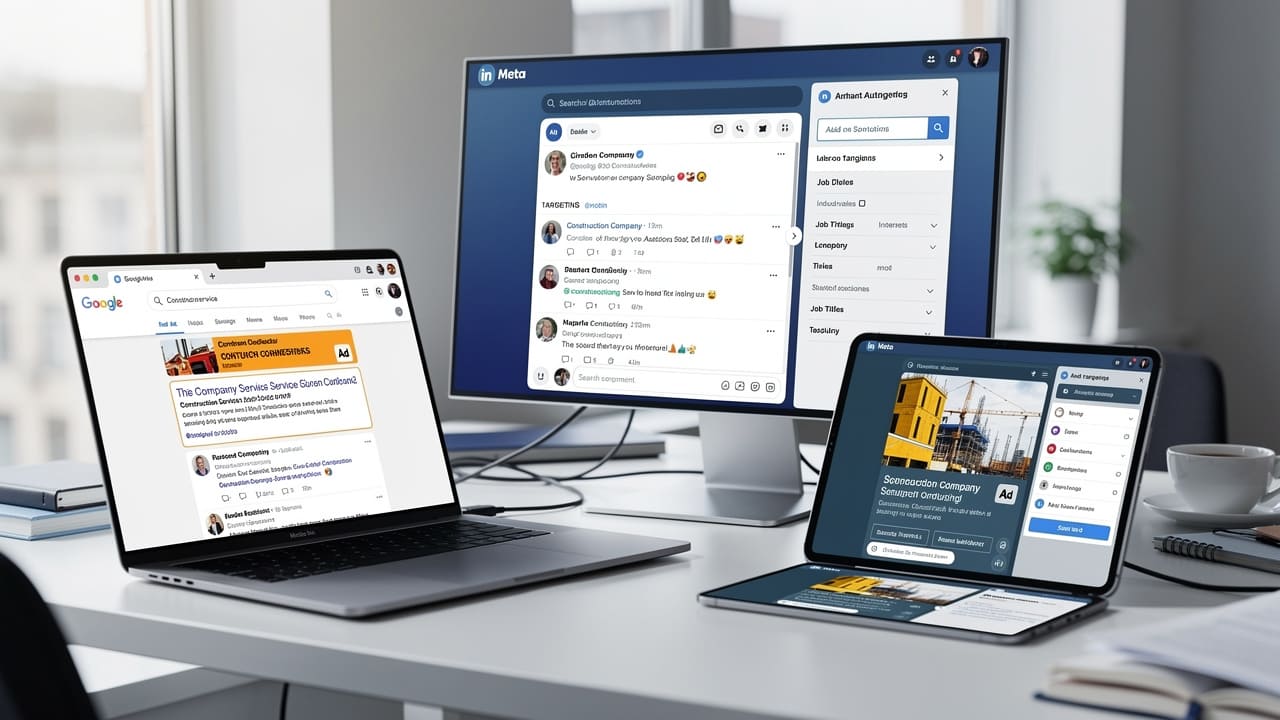
Different platforms serve different segments of the construction market, so budget allocation should match where your buyers actually spend their time. Google Ads specialist captures bottom-funnel intent by placing your company in front of people actively searching for services like “emergency electrical repair” or “crane rental” within your service area.
LinkedIn Ads for B2B reach facility managers, procurement specialists, and other business-to-business decision-makers researching industrial or commercial suppliers, while Meta Ads build local brand awareness and showcase residential projects to homeowners browsing Facebook or Instagram.
| Platform | Best For | Typical Audience |
|---|---|---|
| Google Ads | High-intent searches | Residential, commercial, industrial buyers |
| LinkedIn Ads | B2B relationship building | Facility managers, procurement teams |
| Meta Ads | Local brand awareness | Homeowners, residential clients |
Building Referral Networks and Strategic Partnerships
Referral relationships with architects, engineers, real estate agents, and complementary trades create a steady, low-cost source of qualified leads. Formalizing these connections through a defined referral program, whether a simple commission structure or a reciprocal marketing arrangement, turns casual recommendations into a consistent pipeline. Staying in regular contact with past clients also keeps your company top-of-mind when they need future work or know someone who does.
How Can Content and Branding Build Trust With Commercial Clients?

Content marketing builds trust with commercial and industrial buyers by giving them concrete proof of your capabilities before they ever pick up the phone. Detailed case studies showing project challenges, solutions, and results, paired with before-and-after photography and client testimonials, let prospects evaluate your work the same way they’d evaluate any major purchase. Video testimonials and job-site walkthroughs carry even more weight, since they let a facility manager or general contractor see your team’s professionalism firsthand.
Professional branding consistent logo use, messaging, and visual identity across your website, proposals, and job-site signage, separates established companies from smaller competitors still figuring out their unique selling proposition. Buyers associate polished branding with reliability and long-term stability, which matters when they’re trusting you with a six or seven-figure project. Strong positioning also lets you compete on value rather than price alone.
Why Work With a Strategic Marketing Partner Like Cutting Edge Digital Marketing?
Cutting Edge Digital Marketing works as a strategic marketing partner for construction, trades, and industrial businesses rather than selling disconnected services one at a time. Instead of a generic website development package or a one-off ad campaign, the team builds an integrated system, website, SEO, paid advertising, branding, and content, built around each client’s specific industry and growth stage. This matters because construction companies rarely succeed with scattered tactics; every channel needs to work toward the same qualified-lead goal.
The approach centres on proper tracking from day one, so every marketing dollar connects to a measurable lead rather than guesswork. For companies investing $2,000 to $10,000 monthly, that accountability makes the difference between marketing that feels like a cost and marketing that works as a growth engine. Clients gain an experienced fractional CMO services guiding strategy and execution without the overhead of a full-time hire. Contact us to discuss how a dedicated marketing partner can support your growth plans.
A useful way to judge any marketing spend: if you can’t trace a lead back to the channel that produced it, you can’t tell whether the money is working or just disappearing.
The Takeaway
Construction company marketing works best as an integrated system rather than a handful of disconnected tactics. A fast, locally optimized website captures demand, multi-channel paid advertising accelerates it, content and branding build the trust commercial buyers need, and referral networks add a steady layer of low-cost leads. Companies that track results across every channel know exactly where their budget is working and where it isn’t.
If your current marketing feels inconsistent, or you’re unsure whether your spend is producing real leads, it’s worth reviewing your website, local rankings, and ad performance against the strategies covered here. Partnering with an experienced team gives growth-focused construction, trades, and industrial companies the strategy and execution needed to turn marketing into a reliable source of revenue.
Frequently Asked Questions
How Much Should a Construction Company Spend on Marketing Each Month?
Most established construction and trades companies invest between $2,000 and $10,000 monthly, though the right figure depends on revenue goals and how competitive your market is. Companies pursuing aggressive growth or operating in crowded urban markets typically budget toward the higher end of that range.
How Long Does It Take to See Results From Construction Marketing?
Paid advertising can generate leads within days of launching a campaign, since it puts your company in front of people actively searching for services. SEO and content marketing take longer, usually three to six months, to build the rankings that produce consistent organic leads.
What Marketing Channels Work Best for Industrial and Oil and Gas Companies?
LinkedIn and targeted search advertising typically outperform consumer platforms for industrial and oil and gas companies, since these channels reach procurement specialists and facility decision-makers directly. Pairing both with a detailed, technical website helps these buyers shortlist a supplier faster.
Should Construction Companies Hire an In-House Marketer or Use an Agency?
A full-time marketer fractional CMO pricing but covers only one skill set, while an external strategic partner provides a full team covering strategy, SEO, advertising, and design. For most companies under $20 million in revenue, a marketing partner delivers broader expertise at a lower total cost.
How Do I Measure the ROI of My Construction Company’s Marketing?
Track cost per lead calculator, lead-to-client conversion rate, and revenue attributed to each channel using analytics tools and your customer relationship management system. Comparing these numbers against your total monthly spend shows exactly which channels are producing profitable leads and which need adjustment.
Do Construction Companies Really Need Social Media Marketing?
Yes, though the platform matters more than the posting frequency. LinkedIn builds business-to-business trust with facility managers and procurement teams, while Facebook and Instagram showcase completed residential projects and build local brand recognition among homeowners planning similar work.