
Many owners describe switching on Google Ads as feeding a noisy machine: money goes in, mystery comes out. Bills rise, the phones stay quiet, and the right projects never appear. A focused Google Ads strategy for lead generation is what turns that machine from a blind expense into a steady flow of quotes, bookings, and serious inquiries.
For service-based, industrial, and trades businesses, Google is often where high-intent buyers start their search. Yet we regularly meet companies paying $100–$300 per lead with no clear idea which clicks turn into real work, even though 40+ Google Ads Statistics show that properly optimized campaigns can significantly reduce these costs. Campaigns were set up fast, aimed at broad terms, sent to a generic homepage, and left on autopilot. It is no surprise many owners feel that Google Ads does not fit their field.
“Half the money I spend on advertising is wasted; the trouble is I don’t know which half.”
— John Wanamaker
At Cutting Edge Digital Marketing, we build Google Ads systems for established service-based and industrial companies that rely on steady, profitable lead flow. This guide shares a practical lead generation strategy: from goals and campaign structure to lead capture, targeting, bidding, and measurement, so the path from budget to booked work feels far more concrete.
Key Takeaways
A strong lead generation strategy rests on five pieces: goals, structure, targeting, creative, and tracking. When one is weak, cost per lead climbs.
Campaigns work best when they match how buyers think: awareness, comparison, and ready-to-buy searches each need different messages and offers.
Google Ads, your website, and your CRM should work together so you can see which leads turn into real revenue instead of guessing from clicks alone.
Building Your Foundation: Goals, Audience, And Campaign Structure

Before opening an ad account, we start with business math—reviewing Lead Generation Statistics 2026: trends, benchmarks, and insights that help establish realistic targets for your industry. How many new jobs or contracts do you need each month? What is a profitable cost per lead (CPL) based on margins and crew capacity? Clear numbers turn advertising from a hope into a plan.
At Cutting Edge Digital Marketing, we usually work through:
Set Business Targets
Revenue goal and average deal size.
Leads and close rate needed to hit that number.
Translate Targets Into Ad Goals
For example: “Generate 60 qualified leads per month at $120 or less per lead” or “Reach a 4:1 return on ad spend (ROAS) from Google Ads.”
Agree on leading indicators such as click-through rate (CTR) and conversion rate so you can spot problems early.
Define Your Ideal Customer
Industry, company size, project value, locations served.
Job titles (e.g., plant manager, operations director, GC).
Buying triggers such as shutdowns, breakdowns, or expansion projects.
Account For A Longer Decision Process
Many industrial and B2B services involve several stakeholders.
Plan for remarketing, email follow-up, and sales touchpoints instead of expecting one-click decisions.
Choose Campaign Types To Match Goals
Search Campaigns for high-intent keywords and steady lead flow.
Performance Max to expand reach once you have enough conversions.
Demand Gen to promote educational content and fill the top of the funnel.
Every choice here ties back to business targets, not vanity metrics like impressions alone.
Structuring Campaigns Around The Buyer Funnel
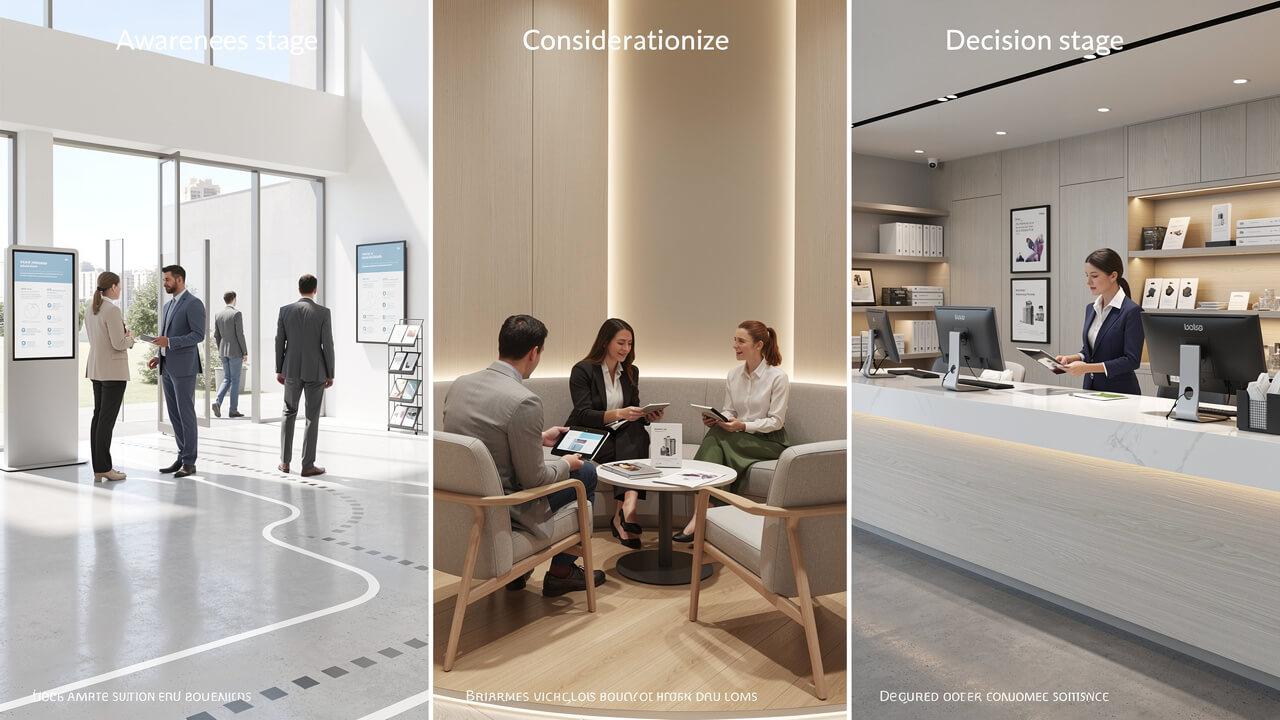
Not every searcher is equal. Someone typing “what is preventive maintenance” is far less ready to talk than someone searching “industrial maintenance contractor near me.” When both people see the same ad and offer, the experience feels wrong and costs rise.
We group campaigns by buyer readiness so we can:
Match keywords, ads, and offers to intent.
Control budget by funnel stage.
See exactly which parts of the funnel feed quotes and contracts.
Awareness Stage Campaigns
At the awareness stage, people are naming a problem, not picking vendors.
Keywords: broader, educational phrases such as “reduce plant downtime” or “marketing ideas for construction companies.”
Goal: introduce your brand with helpful content—guides, checklists, or case studies.
Success signals: time on page, repeat visits, and remarketing list growth, not just form fills.
Consideration Stage Campaigns
Here, prospects understand the problem and start comparing options.
Keywords: more specific, service-focused terms like “Google Ads agency for contractors” or “industrial marketing partner.”
Focus: how your service works, proof from similar clients, and why your approach fits their world.
Offers: strategy calls, product demos, or detailed pricing discussions, not just newsletter sign-ups.
Decision Stage Campaigns
Decision-stage searchers show clear purchase intent and are ready to talk.
Keywords: high-intent phrases such as “emergency boiler repair,” branded searches, and carefully chosen competitor names.
Ads: direct and action-driven with calls like “Request A Quote,” “Book A Consultation,” or “Call Now.”
Landing experience: minimal friction so a prospect can contact you in a few clicks.
Using Google Lead Form Assets For Frictionless Lead Capture

One of the fastest ways to lower CPL is to make contact easier. Google lead form assets place a short form directly inside your ad. When someone taps the ad, a Google-hosted form opens instead of loading your website, often pre-filled with details from their Google account.
This matters for people on the move—on a job site or in a truck—who will not wait for slow pages or fight tiny form fields. Lead form assets remove most of that friction and often convert far better than traditional landing pages on phones.
When we set up lead form assets for clients, we typically:
Choose a lead-focused objective inside the campaign.
Write a clear, benefit-driven headline and description.
Select form fields such as name, email, phone, company, location, and basic project details.
Link to your privacy policy and write a thank-you message that guides the next step.
A key step is routing leads into your systems. By default, Google only stores submissions for 30 days and expects manual exports. At Cutting Edge Digital Marketing, we connect lead forms to your CRM or email platform through a webhook so:
New leads appear instantly in your pipeline.
Notifications reach your team within minutes.
Automated email or SMS follow-up can start right away.
Used as part of a wider system—alongside call tracking and email nurturing—lead form assets become a fast, reliable source of qualified opportunities, not just a pile of disconnected contacts.
Advanced Targeting Strategies: Keywords And Audiences
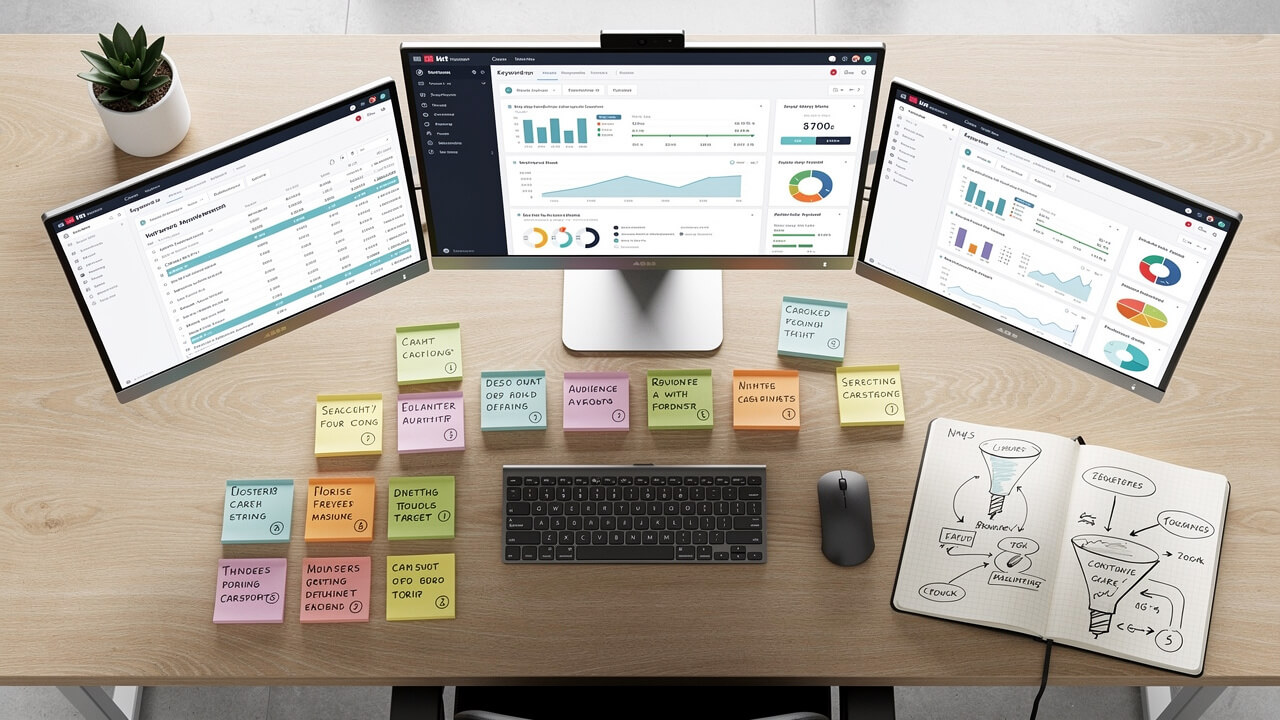
Targeting is where a lot of wasted ad spend hides, which is why Google published a Downloadable report to help businesses understand how to identify and reach high-value audiences more efficiently. Two companies can spend the same budget and see very different results simply because one is speaking to the wrong people.
We focus your keyword and audience strategy around intent:
Map keywords to real buyer questions. High-intent phrases like “roof repair company near me” often deserve higher bids than vague research terms.
Build out long‑tail keywords with more detail (location, job type, industry). These usually cost less and attract better fits.
Use the search terms report to add strong new phrases and block poor ones (for example, “jobs,” “free,” or DIY queries) with negative keywords.
Google’s audience tools provide a second layer of control:
In‑Market Segments to reach people actively comparing services in areas such as construction or business services.
Custom Intent Audiences based on specific keywords and sites your buyers visit.
Customer Match to stay visible to past leads, existing customers, and similar audiences that behave like your best accounts.
We also build remarketing lists from website visitors and past converters. Warmer audiences—such as people who visited pricing pages or multiple service pages—see stronger offers and more direct calls to action. For some B2B clients, we pair this with LinkedIn campaigns and then retarget that engaged audience on Google Search and YouTube to stay present across channels.
Because we work extensively with construction, trades, and industrial clients, we know the language their buyers use. That insight shapes keyword choices, ad copy, and audience settings, which reduces wasted clicks and brings in more of the work you actually want.
Creating High-Converting Ads And Landing Pages

Every click is a small investment. Whether it turns into a real lead depends on what the searcher sees next. The ad and landing page should feel like one continuous conversation.
For ads, we focus on:
Naming the prospect’s pain clearly (“Tired of waiting weeks for quotes?”).
Stating concrete benefits such as faster turnaround, uptime gains, or safer installs.
Adding proof—years in business, industries served, or safety records.
Ending with a strong call to action like “Request A Site Visit” or “Book A Strategy Call.”
Responsive Search Ads let us test many angles at once. We provide multiple headlines and descriptions that talk about different pain points, benefits, and CTAs. Google mixes and matches them based on the search and shifts spend toward combinations that produce more clicks and conversions.
For landing pages, we aim for:
Tight message match with the ad—same service, industry, and benefit language.
One primary CTA (call, quote request, consultation) with minimal distractions.
Fast, mobile-friendly layouts.
Trust signals such as testimonials, client logos, certifications, and case study snippets.
“Never stop testing, and your advertising will never stop improving.”
— David Ogilvy
At Cutting Edge Digital Marketing, we design and refine both ads and landing pages, so we can test headlines, images, form length, and layout together. Small changes—such as moving a phone number above the fold—often lead to meaningful lifts in conversion rate.
Bidding, Budgeting, And Quality Score Optimization
Even strong creative will struggle if bids and budgets are off. Bid too low and your ads rarely appear; bid too high without control and your CPL spirals.
For most lead generation accounts, we rely on Google’s conversion-focused bidding:
Start with Maximize Conversions to gather data quickly.
Shift to Target CPA once we see what a profitable lead costs.
Monitor lead quality, adjusting targets when market conditions or close rates change.
Budget planning is just as important:
Give a healthy share of spend to decision-stage campaigns that drive quick wins.
Reserve part of the budget for awareness and consideration campaigns to keep the pipeline filled.
Avoid spreading limited budgets across too many campaigns; a few well-funded campaigns usually beat many thin ones.
Reallocate spend toward campaigns, locations, and devices that deliver the best leads.
Improving Quality Score lowers cost per click and helps ads win better positions. We:
Group keywords into tight themes.
Write ads that closely match those phrases.
Send traffic to landing pages that clearly focus on the same topic.
Improve technical factors such as page speed and mobile usability.
We often run controlled experiments on bidding strategies, ad copy, and landing pages. Testing on a portion of traffic first lets us roll out only the changes that move CPL and revenue in the right direction.
Measurement, Tracking, And Lead Quality Management
What owners really care about is jobs booked, contracts signed, and revenue generated. To connect those outcomes back to Google Ads, tracking must be set up correctly from day one.
We treat each valuable action as a conversion, including:
Form submissions
Phone calls from ads or landing pages
Live chat starts
Booking or consultation requests
Using tools like Google Tag Manager, we track these events so Google Ads can see which clicks lead to real contact. Features like Enhanced Conversions for leads help maintain accurate reporting even when cookies are restricted.
Tracking cannot stop when a lead hits your inbox. We connect Google Ads to your CRM so every lead is logged with its source campaign, keyword, and ad. Because Google only stores lead form submissions for a short time, this sync often happens through a webhook in real time. That setup also supports:
Instant email or SMS notifications for your sales team
Fast follow-up, often within the first five minutes, when interest is highest
From there, we focus on quality, not just volume. Together with your sales team we define what counts as a sales-ready lead, then track:
How many Google Ads leads reach that stage
How many become customers
The revenue attached to those deals
This lets us talk about cost per qualified lead and ROAS, not just cost per click. We also review attribution reports to see how Google Ads interacts with SEO, email, and offline referrals, then trim spend in weak areas and focus on the channels that clearly drive business results.
Conclusion
Building a profitable Google Ads strategy for lead generation is not about flipping a switch. It means setting clear goals, knowing who you want to reach, and structuring campaigns around how ready those people are to act. From there, strong creative, smart bidding, and tools like lead form assets help turn more clicks into qualified conversations, while solid tracking links spend directly to revenue.
For service-based, industrial, and trades businesses, a generic setup almost always falls short. The best accounts speak the language of your field, match your sales process, and connect tightly with your CRM and follow-up. At Cutting Edge Digital Marketing, we act as a strategic partner for companies that want that kind of disciplined, data-backed approach. If you are ready to turn Google Ads into a steady source of qualified leads at a sustainable cost, reach out to our team to review your current setup and map a clearer path from clicks to contracts.
FAQs
What Is The Average Cost Per Lead For Google Ads?
Across many industries, cost per lead (CPL) from Google Ads often falls in the $30–$50 range, but competitive fields such as legal or finance can be far higher. Keyword intent, ad quality, landing page performance, and targeting all play a role. A focused strategy aims to lower cost per qualified lead over time rather than chasing the cheapest clicks.
How Long Does It Take To See Results From Google Ads?
Your ads can appear within hours, but meaningful data takes longer. Most accounts need 2–4 weeks for Google’s algorithms to learn and for conversions to build. We usually make stronger decisions after about 30 days of consistent traffic, while larger B2B deals may take additional time to close, so we track consultations and quotes along the way.
Should I Use Lead Form Assets Or Landing Pages?
Both matter in a strong lead generation plan. Lead form assets shine on mobile because a quick, pre-filled form reduces friction and often lifts conversion rates. Custom landing pages give you room to explain your offer, show proof, and ask more detailed qualifying questions. We usually test both and match the approach to the complexity of the service and how much information your sales team needs upfront.
What’s The Difference Between Google Ads And SEO For Lead Generation?
Google Ads is paid traffic that appears as soon as a campaign launches, giving you tight control over keywords, spend, and locations. SEO builds unpaid visibility over time through content and technical improvements on your site. Ads can deliver leads quickly, while SEO compounds more slowly; many of the best lead systems use both channels together.
How Do I Know If My Google Ads Leads Are High Quality?
Start by agreeing with your sales team on what counts as a sales-ready lead—for example, project size, location, and decision timeframe. Add a few qualifying questions to your forms, then use your CRM to track which Google Ads leads reach that stage, convert to customers, and generate meaningful revenue. Comparing these metrics by campaign and keyword shows where your strongest leads come from and where to adjust targeting or messaging.