You already know leads cost money to generate. But do you know how much money you are losing every time one of those leads goes unanswered?
Most business owners have a gut feeling that they are missing opportunities after hours, during busy spells, or when the phone rings one too many times. What most owners do not have is a number. A real dollar figure that shows exactly what that missed call, that unanswered website inquiry, or that weekend form submission is actually worth.
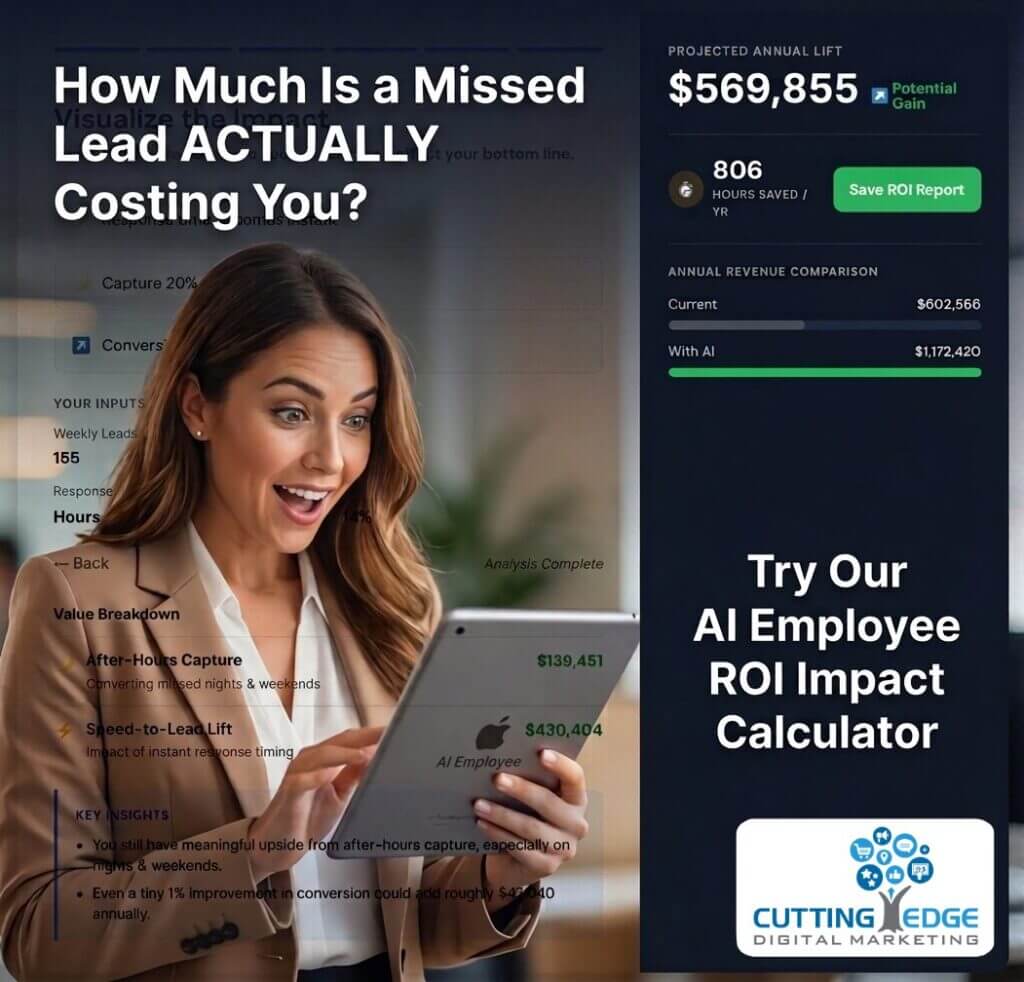
That is exactly why we built our Custom AI Employee ROI Impact Calculator. In under five minutes, you can go from a vague sense of missed opportunity to a clear, data-backed annual revenue projection. This post walks you through the thinking behind the calculator, explains why the numbers matter, and shows you how an AI employee can close the gap between the revenue you are generating now and the revenue you could be generating with 24/7 intelligent coverage.
The Problem No One Talks About: The Silent Revenue Leak
Every business has a version of this problem. A potential customer searches for your service at 9:30 on a Tuesday night. They find you, they like what they see, and they send an inquiry. By Wednesday morning, they have already booked with your competitor because your competitor responded at 11 PM and you responded at 9 AM.
You never even knew the opportunity existed.
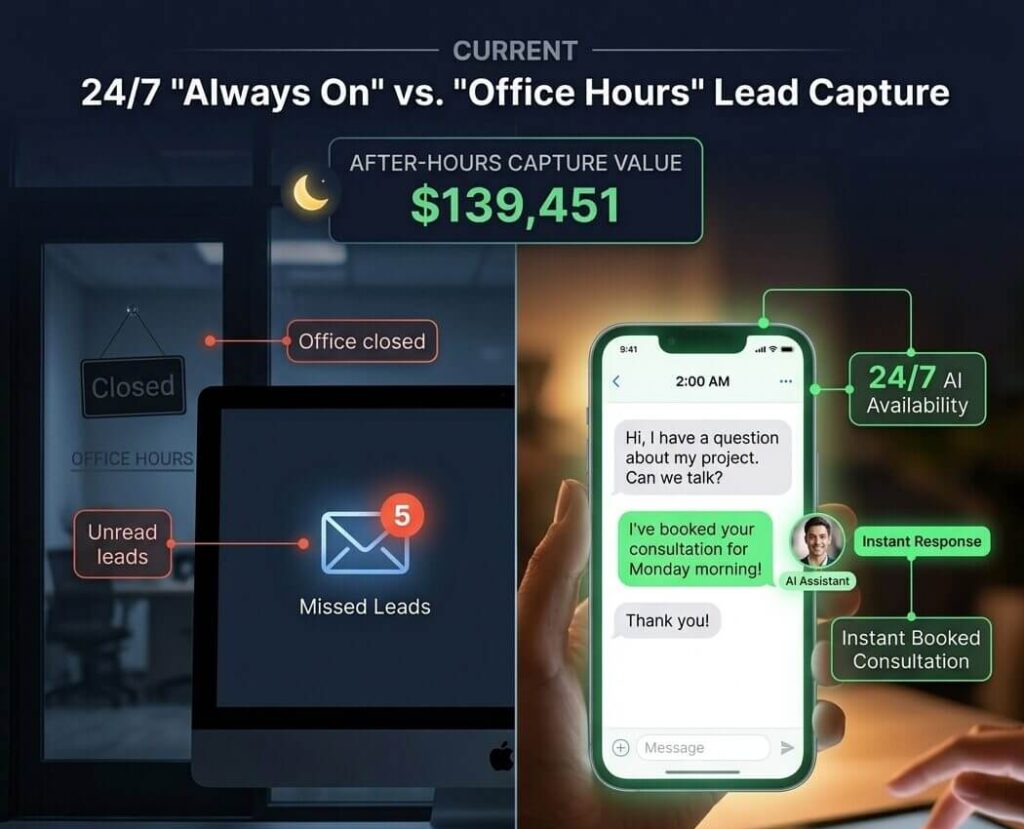
This is not a rare edge case. Research consistently shows that up to 40% of customer inquiries arrive outside of standard business hours in many industries. That is nearly half your potential pipeline showing up when no one is there to catch it.
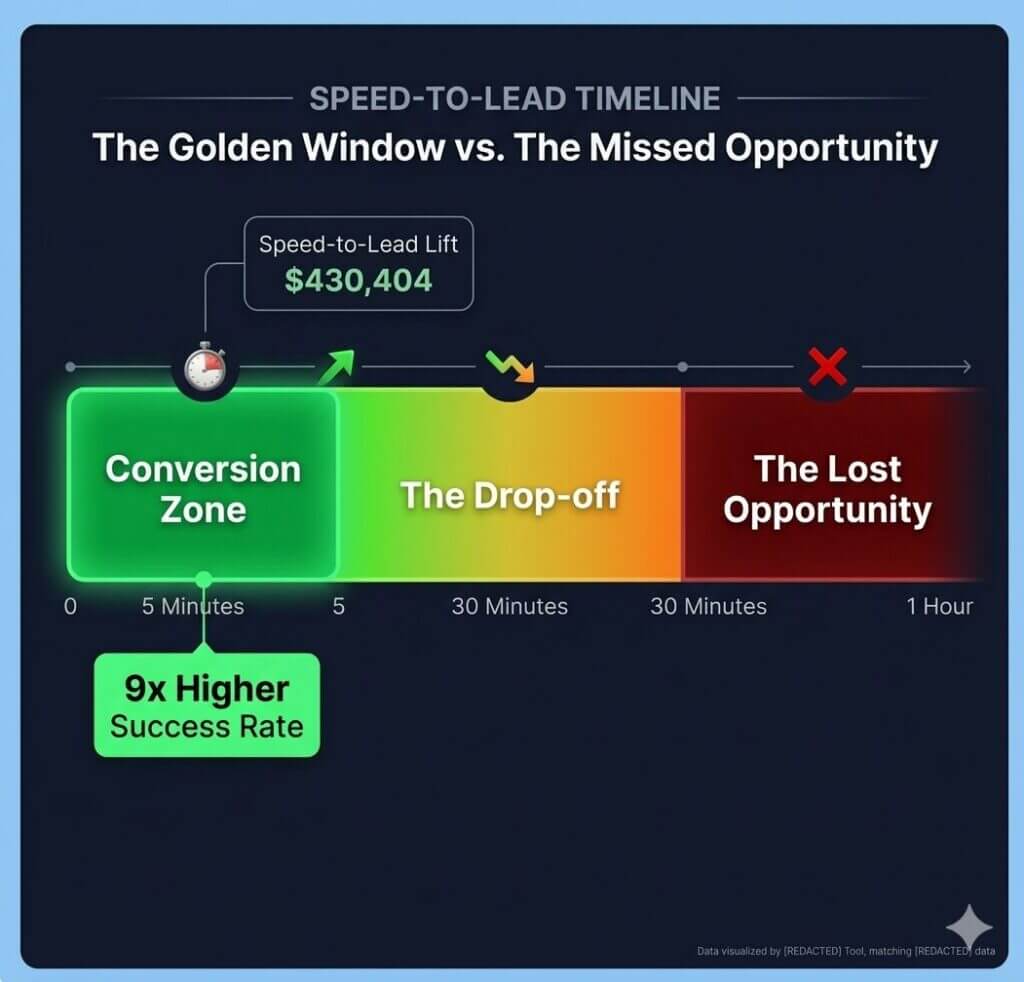
And speed matters just as much as availability. Studies show that businesses responding to leads within the first hour are seven times more likely to qualify that lead compared to businesses that wait longer. The moment a prospect submits a form or sends a message, a clock starts. Every minute you are not responding, your odds of converting that lead drop.
When you add slow response times to after-hours gaps, you get a compounding problem. The result is a quiet, invisible drain on revenue that rarely shows up clearly in any report because you can never see the leads you never captured.
What Our AI Employee ROI Calculator Actually Measures
Our calculator was built on real-world benchmarks, not best-case guesses. It works through your business inputs step by step and produces two core outputs: projected annual revenue lift and hours saved per year.
Here is what the calculator evaluates:
After-Hours Capture Value This measures the revenue you are currently leaving on the table during nights and weekends. The calculator takes your monthly lead volume, applies the percentage of inquiries that arrive after hours, and factors in a realistic conversion rate to show you what consistent 24/7 coverage would add to your annual revenue.
Speed-to-Lead Lift This measures the revenue impact of responding to inquiries instantly versus responding hours later. When an AI employee engages a prospect the moment they reach out, conversion rates climb. The calculator quantifies that improvement based on your average customer value and current response time patterns.
Hours Saved Per Year Beyond revenue, there is a significant time cost to manual follow-up, qualification, and appointment booking. The calculator surfaces how many hours per year an AI employee would recover for your team, hours that can be redirected to higher-value work.
Together, these three figures give you a complete picture of the business case. Not a vague promise about “efficiency gains,” but a grounded estimate of what a 24/7 AI employee would actually do to your bottom line.
The Three Principles Behind the Calculator
1. Response Time Is the Single Biggest Conversion Variable
This is not intuition. This is data. The speed at which you respond to a new inquiry is the most important factor in whether that inquiry converts to a customer.
The reasoning is simple: when a prospect is actively searching, they are in a decision-making mindset. They are comparing options. If you respond first, you frame the conversation. If you respond hours later, you are playing catch-up with a prospect who may have already committed to someone else.
An AI employee eliminates response delay entirely. It engages the moment a form is submitted, a chat message is sent, or a call comes in. There is no queue, no morning check-in, no “I will get back to you.” Just immediate, helpful engagement.
2. After-Hours Availability Is a Competitive Advantage
Most of your competitors have the same staffing constraints you do. Their phones stop being answered at 5 PM. Their chat widgets sit idle on weekends. That creates an opening.
An AI employee that operates 24 hours a day, 7 days a week, 365 days a year does not just recover lost leads. It actively wins business against competitors who are unavailable. Every after-hours inquiry your AI handles is an inquiry your competitor did not.
This is one of the most underappreciated advantages of AI-powered customer engagement. The cost is low. The coverage is total. And the competitive gap it creates is real.
3. Helpful First Impressions Convert Better Than Demanding Ones
There is a significant difference between an AI that immediately asks for a name, email, and phone number and one that first provides genuine value.
The best AI employees lead with help. They answer the question, address the concern, and provide useful information before they ask for anything in return. This approach builds trust. And trust drives conversion.
Businesses that adopt a value-first engagement model have seen conversion rate improvements of up to 20%. When a prospect feels helped rather than harvested, they are far more likely to take the next step.
Our calculator accounts for this conversion improvement as part of the overall ROI calculation.
AI Employees vs. Standard Chatbots: Why the Difference Matters
When most people hear “chatbot,” they think of the frustrating pop-ups that offer a limited menu of pre-written options and force you into scripted dead ends. That is not what an AI employee is.
A standard chatbot reacts to triggers. It matches keywords and returns canned responses. It cannot reason, cannot adapt, and cannot handle anything outside its predefined script.
An AI employee uses a Large Language Model to understand context and intent. It can answer nuanced questions, qualify leads through natural conversation, book appointments, and hand off to a human team member at exactly the right moment. More importantly, it can draw on your business’s specific information, your services, your pricing structure, your policies, to deliver responses that feel tailored rather than generic.
This distinction matters for ROI because the quality of engagement directly affects conversion. A chatbot that frustrates a prospect is not a revenue tool. An AI employee that genuinely helps a prospect move forward is.
How Fast Can You Get Up and Running?
One of the most common hesitations around AI tools is implementation time. Business owners assume that deploying sophisticated AI engagement requires weeks of technical setup, developer resources, and ongoing maintenance.
The reality is much simpler. A well-built AI employee can be deployed in minutes, not weeks. The underlying platform handles the infrastructure. You handle the inputs: your business information, your hours, your services, your goals. The AI does the rest.
This speed-to-deployment means the revenue recovery you calculate in our ROI tool is not a distant future projection. It is something you can start capturing quickly.
What Your Sales Team Gains (Not Loses)
The most common concern when business owners hear “AI employee” is whether it replaces their human team. The answer is no, and here is why the framing matters.
Your sales team’s time is valuable. It is most valuable when they are doing what humans do best: building relationships, navigating complex negotiations, closing deals that require nuance and personal connection.
What your sales team is not particularly suited for is being available at 2 AM, instantly following up on every web form, or spending 30 minutes qualifying a prospect who turns out not to be a fit. Those tasks are repetitive, time-consuming, and frankly, demoralizing.
An AI employee handles the front of the funnel. It captures, qualifies, and schedules. It passes your team warm leads who are ready to talk, freeing your human staff to focus exclusively on conversion and retention.
The result is not replacement. It is leverage. Your team does more with less friction, and your customers get faster, better service at every stage.
Putting a Dollar Figure to It
The ROI calculator exists because “AI is valuable” is not a business decision. A specific dollar amount is.
When you run your numbers, you might find that your business is leaking $40,000 a year in after-hours missed leads. Or $90,000 in speed-to-lead conversion losses. Or a combination that adds up to a revenue lift well above 30%.
Those are the numbers that change decisions. They are the numbers that justify investment, align teams, and create urgency.

We built the calculator specifically so that this conversation does not have to be abstract. Whether you are evaluating AI for your own business or building the case for a client, having a grounded, data-driven projection changes the entire conversation.
Ready to See Your Numbers?
The best time to calculate your AI employee ROI is before you need it. Because by the time you need it, you have already been losing leads.
Use our Custom AI Employee ROI Impact Calculator now and get your projected annual revenue lift, speed-to-lead improvement, and hours saved per year in minutes.
Your competitors are already moving in this direction. The question is whether you are leading the shift or responding to it.