Most Meta ad accounts don’t fail because the ads are bad.
They fail because the metrics are misread.
Meta Ads Manager gives you more data than ever, but more data does not mean more clarity. In fact, the opposite is often true. When advertisers focus on the wrong numbers, they make the wrong changes at the wrong time and quietly kill campaigns that were working.
This article is the final piece in our Meta ads series.
- In Blog #1, we explained why creative is now the primary driver of performance.
- In Blog #2, we broke down how Meta’s AI actually works and how to structure accounts for scale.
- In this article, we focus on how to read performance correctly, so you don’t sabotage everything upstream.
The Core Principle: Metrics Are Lagging Indicators of Creative Quality
Here is the foundation everything else rests on:
Meta metrics do not create performance. They reflect it.
Metrics are lagging indicators of:
- Creative quality
- Offer clarity
- Audience qualification
- Post-click experience
We explain why creative is the primary driver behind these outcomes in our guide on Meta ad creatives for e-commerce.
This is why chasing individual numbers rarely works. You cannot “optimize” your way out of a bad message, and you cannot save a strong creative by misreading short-term data.
The most effective advertisers anchor decisions to a single North Star metric tied to real business outcomes, then support that metric with disciplined experimentation.
Everything else is diagnostic.
What Most Advertisers Get Wrong About Ads Manager
Most advertisers only look at what Meta highlights by default.
That usually means:
- CTR
- CPC
- CPM
- Learning status warnings
Those numbers are not useless, but they are incomplete. On their own, they can hide early signs of wasted spend, broken funnels, or scaling issues.
The most common mistake is confusing high volume with high performance.
More clicks do not mean better clicks.
More leads do not mean better leads.
More engagement does not mean more revenue.
This misunderstanding is the single biggest reason people kill winning ads. They react to surface-level signals instead of reading the system as a whole.
How to Read Metrics by Funnel Stage
Metrics only make sense when viewed in context. A “good” number at one stage can be meaningless or harmful at another.
Cold Traffic: Diagnosing Creative and Audience Fit
Cold traffic metrics are not about profit first. They are about signal quality.
The goal is to determine:
- Does the creative stop the scroll?
- Is the audience receptive?
- Are we paying a reasonable price for attention?
Primary metrics to watch:
Click-Through Rate (Link Click CTR)
This is your first-level creative diagnostic. It tells you whether the hook is working.
- A healthy baseline is often 1.5–2%+, but context matters.
- Anything consistently under 1% usually means the creative needs to change.
CTR here is not a success metric. It is a feedback signal.
CPM (Cost per 1,000 Impressions)
CPM tells you how competitive the auction is.
- Rising CPMs often indicate overly narrow audiences or heavy competition.
- High CPMs require either broader targeting or stronger creative to justify the cost.
CPC / Cost per Landing Page View
These metrics tell you how efficiently spend turns into actual site traffic.
- High CPC usually means weak creative, expensive audiences, or both.
- Landing Page View is more reliable than Link Click, as it filters out accidental taps.
Hook Rate / 3-Second Video Views (for video)
This measures whether people stop scrolling at all.
- Weak hook rates almost always mean the first frame or opening message needs work.
- If people do not stop, nothing else matters.
Early Conversion Signals
Even on cold traffic, you should see some intent:
- ViewContent
- Add to Cart
- Scroll depth
High CTR with no early actions usually signals a disconnect between the ad promise and the landing page.
Cold Traffic Summary
| Metric | What It Diagnoses | Why It Matters |
|---|---|---|
| CTR | Creative hook | Does it stop the scroll? |
| CPM | Auction pressure | Are you paying too much for visibility? |
| CPC / LPV | Efficiency | Are users actually reaching your site? |
| Hook Rate | Video quality | Do people pause at all? |
| Early actions | Message match | Does the page fulfill the promise? |
When CTR Matters and When It Stops Mattering
A “good” CTR is one that:
- Beats your own account average
- Produces reasonable CPC
- Leads to meaningful on-site behavior
CTR becomes a vanity metric when:
- You are optimizing for conversions, not clicks
- CTR is high but CPA exceeds profit margins
- Low-CTR campaigns generate higher revenue
- You have a high-converting landing page and educated traffic
Some of the most profitable campaigns we see run at 0.5–0.8% CTR because they speak to a narrow, high-intent buyer.
CTR is most useful for:
- Creative testing
- Diagnosing fatigue
- Identifying complete message failure
This is why we treat CTR as a creative diagnostic, not a performance metric, as outlined in our breakdown of what actually makes Meta ad creative convert.
It stops mattering once ROAS and CPA stabilize.
Retargeting: Separating Signal from Noise
Retargeting success is not measured by how many people click again. It is measured by what they do after.
High-Quality Retargeting Signals
- Strong conversion rate
- Meaningful time on site
- Multiple page views
- Add to Cart and Initiate Checkout events
- Stable frequency
- “Above Average” quality rankings
Retargeting audiences built on Add to Cart or Checkout Initiated almost always outperform generic website visitors.
Noisy Retargeting Signals
- Very high CTR with low conversion
- Bounce rates above ~80%
- Session times under 10 seconds
- Rising frequency with flat conversions
- High CPMs without revenue lift
Audience Network traffic is a common source of low-quality clicks and should be evaluated carefully.
How We Judge Retargeting Performance
We look at behavior first, revenue second.
Behavioral intent tells Meta who to prioritize. ROAS confirms whether the system is doing that profitably.
Chasing instant sales without confirming intent often leads to overbidding and unstable results.
Bottom Funnel: Where the Truth Lives
At the bottom of the funnel, ROAS is the primary truth metric for e-commerce.
For lead generation or SaaS, CPA and conversion rate often matter more initially, with revenue realized later.
When ROAS Is “Good Enough” to Scale
Scaling decisions are not about hitting a magic number. They are about consistency and risk.
We look for:
- Profitability above breakeven for 3–7 consecutive days
- Sufficient volume (often ~50 conversions in 30 days)
- Low frequency on cold traffic
- Clear evidence sales are coming from high-intent sources
Sometimes scaling means accepting lower ROAS to increase total profit.
A lower ROAS at higher spend can still generate significantly more net revenue, especially when customer lifetime value is strong.
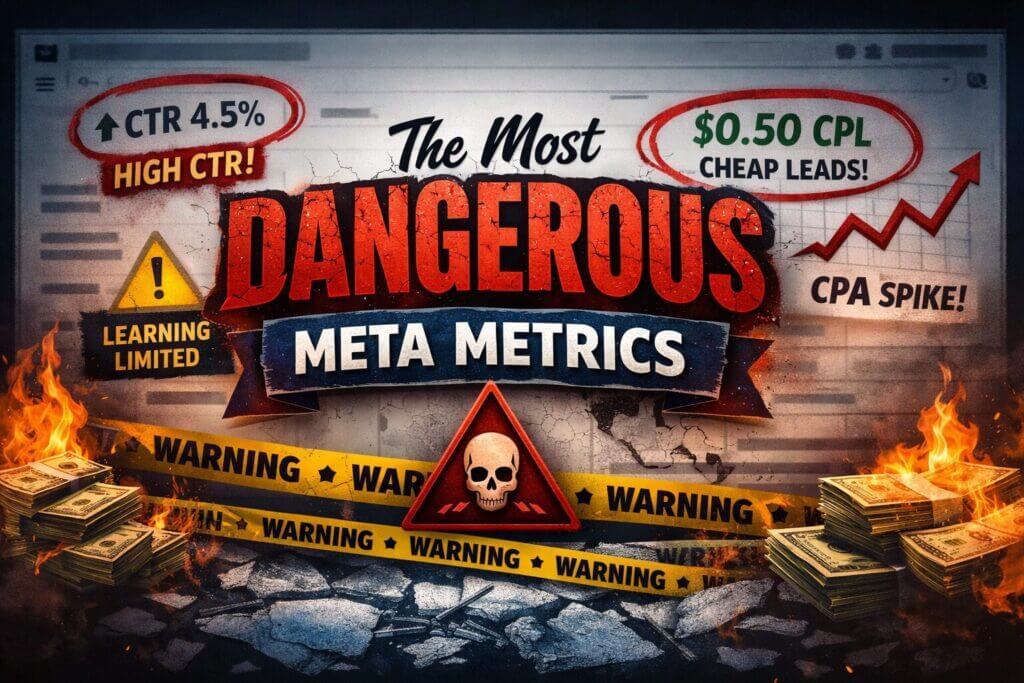
The Most Dangerous Metrics in Meta Ads
Some metrics are not just unhelpful. They are actively misleading when taken at face value.
- CTR
- Cheap CPL
- Comments and reactions
- Learning phase warnings
- Single-day CPA spikes
These numbers often look impressive while masking fundamental problems in qualification, offer strength, or post-click experience.
We routinely see campaigns that “look amazing” in Ads Manager and quietly lose money because aesthetics, engagement, or click volume are mistaken for business performance.
The 7-Day Rule: Why Patience Is Not Optional
Meta’s system needs time to learn.
That learning behavior only makes sense once you understand how Meta’s AI optimization system actually works.
Reacting within 24–72 hours almost always:
- Disrupts learning
- Increases volatility
- Raises costs
- Creates false conclusions
We enforce a minimum seven-day evaluation window unless there is a clear technical failure.
When We Will Act Early
- Obvious tracking issues
- Broken landing pages
- Significant spend with zero meaningful signals
Outside of those scenarios, inactivity is often the correct move.
Diagnosing Performance Drops Without Guessing
When performance dips, the first question is always:
Is this real, or is the data lying?
Step 1: Validate the Data
- Pixel and CAPI firing correctly
- No reporting delays
- No site changes or pricing errors
Many of these issues are amplified or masked entirely by poor account structure, which we break down in our Modern Meta Playbook.
Step 2: Check Creative Fatigue
- Declining CTR
- Rising frequency
- Increasing CPC
Step 3: Evaluate External Factors
- Seasonality
- Competitive spikes
- Platform volatility
If there is no obvious cause, we wait three days before making changes.
How We Isolate the Root Problem
| Issue | CTR | Frequency | Bounce Rate | CVR | Key Signal |
|---|---|---|---|---|---|
| Creative fatigue | Down | Up | Stable | Down | Audience boredom |
| Bad traffic | Down | Low | High | Very low | Wrong people |
| Landing page issue | Up | Low | High | Low | Message mismatch |
| Tracking issue | Normal | Normal | Normal | Zero | Data failure |
One of the most common false problems advertisers try to fix is low CTR, when the real issue is a weak offer or poor landing page experience.
Case Study: When the Metrics Look Bad but the Business Wins
In one campaign, we generated 300+ leads on approximately $600 in ad spend.
To an inexperienced advertiser, the campaign looked poor:
- Cost per lead appeared too low for the niche signaling bad leads
- Immediate ROAS was low
- Revenue was not instant
But the signals that mattered told a different story:
- High-intent form submissions
- Strong follow-up engagement
- Sales conversations progressing
Within 30 days, three leads converted into paying customers.
Those three sales covered the entire ad spend for nearly six months, with dozens of additional leads still active in the pipeline.
Judged correctly, this campaign was a success from the start. Judged by surface metrics, it would have been killed prematurely.
Final Rules for Reading Meta Metrics
Ignore soft engagement metrics. Judge success by business outcomes.
Do not manage ads like day trading. Treat them like an investment portfolio.
That mindset aligns directly with how we recommend structuring and scaling Meta accounts for long-term stability.
Disciplined advertisers plan, measure, and intervene with intent. Reactive advertisers chase numbers, panic early, and reset learning repeatedly.
The difference shows up in ROAS, stability, and stress levels.
The Bottom Line
Meta ads do not fail because of bad metrics.
They fail because metrics are misinterpreted.
If you understand what the numbers actually represent, when to act, and when to do nothing, Meta becomes far more predictable and far more profitable.
That is the difference between guessing and scaling.