If running Meta ads feels like you are donating money to Mark Zuckerberg, you are not alone.
We work with small to mid-size e-commerce brands and scaling companies every day that are spending money consistently but feel stuck. They have traffic. They have engagement. But revenue is unpredictable, ROAS is unstable, and no one can clearly explain why some ads work and others quietly burn cash.
This guide exists to close that gap.
It is written for:
- E-commerce brands already spending on Meta but hitting a performance ceiling
- Beginners who are tired of guessing
- Teams ready to move from “trying things” to running a repeatable system
This is not theory. It is the result of nearly a decade in the trenches, managing Meta ads for more than 50 e-commerce brands across apparel, supplements, home goods, events, and digital products. We have seen every algorithm shift, creative trend, and shiny new tactic come and go. What remains are core principles that consistently drive results.
The Hard Truth: Creative Is the Targeting Now
On modern Meta, creative does the heavy lifting.
Yes, targeting still matters. Buyer personas still matter. But the ad itself is what tells Meta who should see it. The hook, the visuals, the message, and the clarity of the offer are what separate buyers from browsers.
If your creative is weak, no audience stack will save you.
If your creative is clear, honest, and intent-driven, Meta will do the rest.
We break down exactly how Meta’s AI interprets and scales these creative signals in our Modern Meta Playbook, including why simplified account structure now outperforms complex targeting.
What Creative Actually Performs vs. What Fails
What Consistently Underperforms
- Overdesigned graphics that look like ads
- Stock photos that feel generic and untrustworthy
- Brand-first messaging that ignores the customer’s problem
- Lifestyle imagery with no context or explanation
Pretty does not convert. Clarity does.
What Consistently Performs
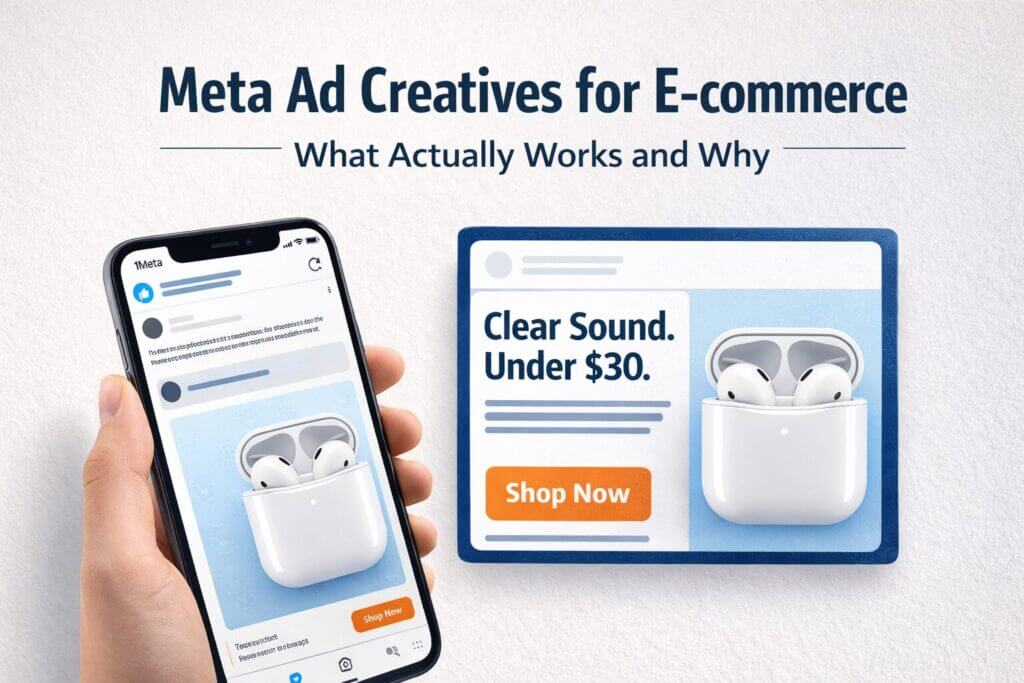
- Simple benefit plus price
- Problem-solution visuals
- UGC-style demos that feel native to the feed
- Founder-led content that builds a human connection
“Ugly ads” do not always win. This is a myth. Polish still matters. But brand perfection comes second to direct-response fundamentals. Clear visuals, good lighting, clean audio, and strong structure outperform cinematic fluff every time.
The Anatomy of a High-Performing Meta Ad Creative
Visual Hook (First 1–2 Seconds)
- Immediate contrast to stop the scroll
- One clear subject, no clutter
- Human presence when relevant
Clear Message at a Glance
- One core takeaway
- Short, readable text
- Plain, conversational language
Strong Composition
- Mobile-first framing
- Safe text placement
- Obvious visual hierarchy
Brand Recognition Without Overdoing It
- Consistent look and feel
- Subtle logo usage
- Real people and environments
Emotional or Practical Trigger
- Show the problem or desire
- Make it relatable
- Show the outcome
Authenticity Over Polish
- Real beats perfect
- Native feed-style content
- Avoid stock imagery
Clear Call to Action
- One action only
- Low friction
- Visually obvious
Platform Best Practices
- Minimal text density
- High resolution
- Correct aspect ratios
Built for Testing
- Simple layouts
- One variable per test
- Easy to iterate
Why Pricing in E-commerce Ads Matters More Than Most Brands Want to Admit
One of the most common mistakes we see is hiding the price.
Brands do this out of fear. Fear that the price will scare people away. Fear that clicks will drop. Fear that engagement will look worse.
That fear is usually misplaced.
Pricing Pre-Qualifies Clicks
When someone clicks an ad without knowing the price, you are paying for curiosity, not intent.
By showing the price, you immediately filter out people who were never going to buy. The clicks you do get are more serious, more qualified, and far more likely to convert.
Lower volume does not mean worse performance. It often means better performance.
Pricing Reduces Bounce Rate and “Price Shock”
A massive portion of e-commerce bounce happens the moment the price is revealed.
If users already know the price before they click, fewer people land on the page and leave instantly. That improves conversion rates and sends cleaner data back to Meta, which improves optimization over time.
Pricing Builds Trust and Sets Expectations
Transparent pricing feels honest.
Hidden pricing feels like a trick, even when it is not intended that way. Ads that show pricing attract buyers who arrive mentally prepared to make a decision. Trust starts in the ad, not on the checkout page.
Cost per purchase and ROAS almost always improve. Meta also learns faster when post-click behavior is cleaner. Fewer junk clicks mean better signals and more predictable scaling.
Knowing how to read that data correctly is critical, which is why we break down which Meta ads metrics actually matter and which ones quietly sabotage ROAS.
Pricing Discourages Bad Traffic
Without pricing, ads attract:
- Window shoppers
- Competitors
- People who just want to see “how much it costs”
Pricing weeds them out before they cost you money.
Case Study: What Happens When You Stop Hiding the Price
We worked with an e-commerce brand that intentionally hid its pricing in their ads to drive clicks.
The result was exactly what you would expect:
- High engagement
- Lots of curiosity clicks
- Poor conversion quality
As a last-minute test, we added the price directly into the ad creative. No other changes. Same audience.
The result:
- ~$3,000 in sales
- ~$250 in ad spend
Nothing else changed. No new targeting. No funnel rebuild. Just pricing transparency.
By showing the price upfront, we stopped paying for curiosity and started paying for intent. Fewer clicks. Better buyers. Real revenue.
This is why pricing is not a risk in e-commerce. It is a filter.
When Pricing Works Best in Ads
Pricing performs especially well when:
- Products are under $100
- The offer is clear and focused on a single product
- You are advertising to cold traffic
- You are retargeting users who already know the product
- You are running a sale or promotion
When You Might Not Show Exact Pricing
There are exceptions:
- Highly configurable products
- Premium or luxury items where positioning matters more than speed
- B2B or high-ticket offers that require a discovery phase
Even then, a “starting at” price is usually better than nothing. Context matters.
How to Show Pricing Without Killing Performance
Price should never stand alone. It should support the value.
Good examples:
- “$49. Free shipping. No subscription.”
- “Under $30. Built to last.”
- “$79 and replaces three products.”
Pair price with a reason:
- “$39. Made in Canada.”
- “$89. 2-year warranty included.”
- “$59. One-time purchase.”
The price should be readable, not dominant. The product and the benefit lead. The price simply removes uncertainty.
The Golden Rule of Meta Optimization: Don’t Touch Winning Ads
This is not optional advice. This is a commandment.
The biggest mistake advertisers make is trying to “improve” ads that are already hitting ROAS targets.
This behavior makes more sense once you understand how Meta’s AI learning system actually works and why stability is required for efficient scaling.
When you edit a winning ad, Meta resets the learning phase. Performance often collapses, and people are left wondering what went wrong.
If you want to test something new, duplicate the ad or ad set. Never tinker with the engine while the car is winning the race.
How to Optimize a Winning Meta Ad Without Breaking It
Yes, you should optimize a converting Meta ad.
But you need to do it carefully.
The goal is not to “fix” a winning ad. The goal is to scale or refine it without triggering unnecessary instability. Most advertisers lose momentum because they confuse optimization with constant tinkering.
If an ad is already delivering a healthy ROAS, your job is to protect it while extracting more value.
Here’s how to do that safely.
Smart Ways to Optimize a Converting Ad
Scale vertically (low risk)
If an ad is profitable, increase the budget gradually. A good rule of thumb is 15–20% every two to three days. This gives Meta time to adjust without forcing the ad back into a full learning phase.
Scale horizontally (low risk)
Take the exact winning creative and copy and test it in:
- A broader version of the same audience
- A similar or lookalike audience
- Additional proven placements
You are expanding reach without changing the thing that already works.
Refresh creative when frequency rises (necessary)
If performance dips due to ad fatigue, do not touch the original winner. Create a variation instead:
- New headline
- New hook
- New thumbnail or opening frame
This keeps performance stable while extending the life of the concept.
Adjust the optimization goal (situational)
If an ad is converting consistently, shifting from “Maximum number of conversions” to “Maximum value of conversions” can help Meta prioritize higher-value buyers instead of just more buyers.
Consolidate when possible (often overlooked)
If you have multiple ad sets performing similarly, combining them can improve performance. Fewer, stronger data signals often outperform fragmented setups and lead to more stable delivery.
What Not to Do (This Is Where Most Accounts Break)
- Do not make multiple changes at once.
Changing targeting, budget, and creative simultaneously guarantees unclear results. - Do not panic over short-term fluctuations.
A slight increase in cost per result does not mean an ad is failing. Always evaluate performance over at least a seven-day window before making decisions. - Do not turn off a winning ad just because you’re bored with it.
If it’s making money, your opinion is irrelevant.
Why This Matters
Meta rewards stability.
That stability only holds if you know how to evaluate performance without reacting to misleading short-term metrics.
The advertisers who win long-term are not the ones constantly chasing “perfect.” They are the ones who protect what works, scale deliberately, and only intervene when the data clearly justifies it.
Optimization is about discipline, not activity.
Simple Decision Tree: Should You Touch This Meta Ad?
Use this before making any change to a live campaign.
Start here: Is the ad currently profitable (or trending profitable)?
→ YES
- Has performance been stable for at least 7 days?
- Yes → Do not edit the ad
- Scale budget slowly or duplicate to new audiences
- No → Wait. Do nothing yet.
- Yes → Do not edit the ad
- Is frequency climbing and performance slipping?
- Yes → Create a new variation (headline, hook, or thumbnail)
- No → Leave it alone.
→ NO
- Is the ad still in the learning phase or under 7 days old?
- Yes → Do not touch it yet
- No → Pause or replace with a new creative test
One Rule That Overrides Everything
If you cannot clearly explain why you are making a change, do not make one.
Activity is not optimization. Discipline is.
Real-World Results
Pricing Power
One e-commerce brand was hiding pricing to “build mystery.” We added price to a last-minute test. Result: $3,000 in sales on $250 in ad spend.
Creative Shift
Another brand had strong engagement but weak sales. We replaced brand-first lifestyle shots with problem-solution UGC. Result: over 300 leads in the first month on a $600 budget.
Case Study: Why Lead Quality Beats Cheap Results Every Time
Another brand came to us frustrated. Their ads were getting reach and engagement, but sales were inconsistent. The creative was polished, brand-heavy, and focused more on aesthetics than outcomes.
We rebuilt the ads around:
- Problem–solution messaging
- UGC-style creative
- Clear qualification in the first few seconds
The results in the first month:
- 300+ leads generated through form submissions in the first month
- Under $500 total ad spend in the first month
Out of those leads:
- 3 converted into paying customers
- Those 3 sales covered the entire ad spend and management fee for nearly six months
- After the first month, dozens of additional leads were still active in the pipeline, actively evaluating and moving toward a purchase
If you judged this campaign purely on cost per lead, you would miss the point completely.
This campaign worked because it attracted real buyers, not just people filling out a form. Meta ads do not need to close every sale immediately to be successful. They need to start the right conversations with the right people.
That is how you build sustainable ROAS instead of chasing short-term metrics.
The Meta Creative Do and Don’t List
Do
- Show pricing to pre-qualify buyers
- Design mobile-first
- Test multiple hooks per product
- Focus on the customer benefit
Don’t
- Hide pricing to protect vanity metrics
- Use desktop-first layouts
- Edit winning ads
- Lead with brand aesthetics
Final Checklist: Is Your Ad Ready?
- The 2-second hook stops a fast scroller
- The price or starting price is clear
- Captions exist for sound-off viewers
- One clear CTA is present
- The product use-case is obvious
The Bottom Line
Great Meta ad creative does not try to convince everyone.
It attracts the right people and repels the wrong ones. Pricing helps with that. Clarity helps with that. Honest creative helps with that.
When your ads qualify before the click, everything downstream improves. Cleaner data. Better ROAS. Predictable growth.
That is what actually works.